What Are Lab-Grown Diamonds?
Lab-grown diamonds — also called lab-created, synthetic, or cultured diamonds — are real diamonds produced in controlled laboratory environments rather than extracted from the Earth. They share the identical chemical composition (pure carbon arranged in a cubic crystal lattice), physical properties, and optical characteristics as natural diamonds. When examined under standard gemological equipment, a lab-grown diamond is indistinguishable from its mined counterpart.
The technology to produce gem-quality lab-grown diamonds has advanced rapidly since the early 2010s. What was once limited to small, industrial-grade crystals has evolved into a mature industry capable of growing colourless stones exceeding 10 carats. For Canadian consumers, this means access to diamonds that look, feel, and test identical to stones from the Northwest Territories — at a fraction of the price.
It is important to understand the distinction between lab-grown diamonds and diamond simulants. Simulants such as cubic zirconia (CZ) and moissanite merely look like diamonds but have entirely different chemical compositions and physical properties. Lab-grown diamonds are diamonds in every measurable sense — they simply did not form underground over billions of years.
How Lab-Grown Diamonds Are Made: HPHT vs CVD
Two primary methods dominate lab-grown diamond production. Each replicates a different aspect of the natural diamond formation process, and both produce gem-quality stones suitable for jewellery.
High Pressure High Temperature (HPHT)
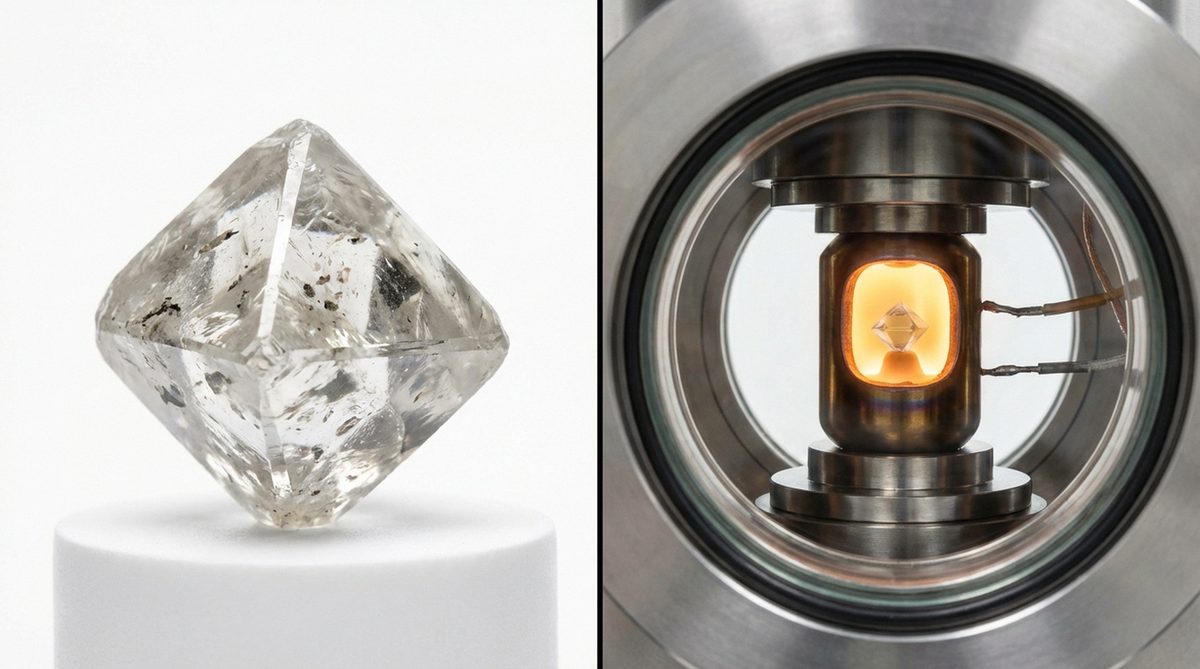
HPHT was the first method used to synthesise diamonds, pioneered by General Electric in 1954. The process places a small diamond seed crystal inside a press containing a carbon source (typically graphite) and a metallic catalyst (iron, nickel, or cobalt). The press applies extreme pressure — approximately 5 to 6 gigapascals — while heating the chamber to 1,300–1,600°C. Under these conditions, the carbon dissolves into the molten metal catalyst and crystallises onto the seed, growing a larger diamond over several days to weeks.
HPHT diamonds tend to exhibit a cuboctahedral growth pattern, which can leave metallic flux inclusions visible under magnification. The process can also introduce nitrogen atoms into the crystal lattice, giving stones a faint yellow or brownish tint. To achieve colourless or near-colourless grades, HPHT diamonds often undergo post-growth treatment — either additional HPHT processing to remove colour centres or irradiation and annealing to produce fancy colours.
Chemical Vapour Deposition (CVD)
CVD has become the preferred method for producing large, colourless gem-quality diamonds. A thin diamond seed plate is placed inside a vacuum chamber, which is then filled with a carbon-containing gas — typically methane (CH₄) mixed with hydrogen (H₂). Microwave energy or a hot filament ionises the gas into a plasma, breaking the methane molecules apart. The freed carbon atoms settle onto the seed and bond layer by layer, building up the diamond crystal.
CVD operates at much lower pressures than HPHT (typically 1–27 kPa) and moderate temperatures of 700–1,200°C. Growth rates vary from 0.1 to 10 micrometres per hour depending on the reactor design. Modern CVD reactors can grow a rough diamond crystal of several carats in two to four weeks. The resulting stones tend to be purer than HPHT diamonds, with fewer metallic inclusions and better colour consistency.
Key Difference: HPHT mimics the conditions deep within the Earth (high pressure, high heat). CVD grows diamonds from gas at much lower pressures. Both produce genuine diamonds, but CVD dominates production for stones above 1 carat due to better colour control and scalability.
Lab-Grown vs Natural Diamond Prices in Canada (2026)
The price gap between lab-grown and natural diamonds has widened significantly since 2020. Increased global production capacity — particularly from India and China — has driven lab-grown diamond prices down by approximately 30–40% per year. The table below compares average retail prices in the Canadian market for round brilliant diamonds with G colour and VS2 clarity.
| Carat Weight | Lab-Grown (CAD) | Natural Mined (CAD) | Savings |
|---|---|---|---|
| 0.50 ct | $350–$600 | $1,800–$2,800 | ~78% |
| 0.75 ct | $550–$900 | $3,200–$4,500 | ~80% |
| 1.00 ct | $800–$1,500 | $5,000–$8,000 | ~80% |
| 1.50 ct | $1,200–$2,400 | $9,000–$15,000 | ~83% |
| 2.00 ct | $1,800–$3,500 | $16,000–$28,000 | ~87% |
| 3.00 ct | $3,000–$6,000 | $35,000–$60,000 | ~90% |
Sources: Canadian jeweller price surveys, Rapaport Diamond Report, retailer listings (Q1 2026). All prices in Canadian dollars for round brilliant, G colour, VS2 clarity, Excellent/Ideal cut.
Comprehensive Comparison: Lab-Grown vs Mined Diamonds
Beyond price, there are several factors Canadian buyers should weigh when choosing between lab-grown and natural diamonds. The following table provides a side-by-side comparison across the most important criteria.
| Factor | Lab-Grown | Natural Mined |
|---|---|---|
| Price | 60–80% less than natural equivalent | Premium pricing; holds baseline value |
| Resale Value | Minimal (10–20% of purchase price) | Moderate (30–50% of retail on secondary market) |
| Environmental Impact | 250–750 kWh per carat; depends on energy source | Land disturbance, water use; strict regulation in Canada |
| Hardness | 10 on Mohs scale (identical) | 10 on Mohs scale (identical) |
| Certification | GIA, IGI, GCAL — marked "Laboratory Grown" | GIA, AGS, CanadaMark — natural origin noted |
| Rarity | Unlimited production capacity | Finite supply; declining Canadian production |
| Emotional Value | Modern, technology-forward choice | Geological wonder; billions of years old |
| Insurance | Insured at replacement cost (lower premiums) | Insured at appraised value (higher premiums) |
Canadian Lab-Grown Diamond Producers and Retailers
Canada's lab-grown diamond sector is still emerging compared to the country's established natural diamond mining industry. However, several Canadian companies have entered the space, and the market is expanding rapidly.
Manulab Diamonds (Montréal, QC) operates multiple CVD reactors and produces diamonds up to 3 carats. The company markets its stones as "made in Canada" and emphasises the use of Québec's abundant hydroelectric power — one of the cleanest energy grids in the world — to power its growth chambers.
Tecdia Canada (Vancouver, BC) focuses on both industrial and near-gem quality diamonds using proprietary CVD technology. While their primary market is industrial applications (cutting tools, thermal management), their gem-quality output has grown.
University of Alberta Diamond Research — Researchers at the University of Alberta's Department of Earth and Atmospheric Sciences have contributed significantly to CVD diamond growth technology. Their work on nitrogen-vacancy centres and isotopic analysis has advanced both the science and commercial viability of lab-grown diamonds in Canada.
On the retail side, Canadian consumers can purchase lab-grown diamonds from dedicated online retailers such as Clean Origin Canada, Qudera, and Ritani, as well as traditional jewellers like Birks and Peoples, which now carry lab-grown lines alongside natural diamonds.
GIA Grading for Lab-Grown Diamonds
The Gemological Institute of America (GIA) began issuing full grading reports for lab-grown diamonds in 2020, replacing their earlier descriptive "Synthetic Diamond Grading Report." Today, GIA evaluates lab-grown diamonds using the same 4Cs framework applied to natural stones: cut, colour, clarity, and carat weight.
Key features of a GIA lab-grown diamond report include:
- Clear origin disclosure — The report header states "Laboratory Grown Diamond" prominently.
- Laser inscription — The diamond's girdle is inscribed with "LG" followed by the GIA report number, visible under magnification.
- Full 4Cs assessment — Colour graded on the D-to-Z scale, clarity from FL to I3, cut from Excellent to Poor.
- Growth method identification — The report notes whether the diamond was produced via HPHT or CVD.
- Post-growth treatments — Any treatments (such as HPHT colour enhancement) are disclosed.
The International Gemological Institute (IGI) is the other major grading body for lab-grown diamonds and is particularly dominant in the Indian production market. Both GIA and IGI reports are widely accepted by Canadian retailers and insurers.
Resale Value: The Uncomfortable Truth
One of the most significant differences between lab-grown and natural diamonds lies in their secondary market value. Natural diamonds, while not a reliable "investment" in the traditional sense, do retain a portion of their value. A well-graded natural diamond can typically be resold for 30–50% of its retail price through jewellers, consignment services, or online platforms.
Lab-grown diamonds, by contrast, have almost no resale market in 2026. Several factors contribute to this:
- Falling production costs — New lab-grown diamonds are cheaper every year, making used stones uncompetitive.
- Unlimited supply — Unlike natural diamonds, there is no scarcity to support prices.
- Retailer buyback policies — Most Canadian jewellers do not offer buyback or trade-in programmes for lab-grown stones.
- Insurance implications — Replacement cost (for insurance purposes) is based on current market prices, which decline annually.
For buyers who prioritise the emotional and aesthetic value of a diamond over its financial return, the resale question may be irrelevant. A lab-grown diamond still delivers the same brilliance, fire, and durability as a natural stone — it simply costs less upfront and is worth less later.
Environmental and Ethical Comparison
The environmental footprint of lab-grown versus natural diamonds is one of the most debated topics in the jewellery industry. Marketing claims from both sides can be misleading, so it helps to examine the data.
Lab-Grown Diamond Environmental Footprint
- Energy consumption: CVD production requires approximately 250 kWh per carat; HPHT requires 500–750 kWh per carat.
- Carbon emissions: Vary enormously depending on the energy grid. A lab in Québec running on hydroelectric power produces a fraction of the CO₂ compared to a coal-powered facility in China or India.
- Water use: Minimal compared to mining — primarily for cooling systems.
- Land disturbance: None. Lab-grown production occurs in industrial buildings.
Canadian Natural Diamond Environmental Footprint
- Energy consumption: Mining operations consume significant energy for extraction, crushing, and processing. The Diavik mine alone consumed approximately 90 million litres of diesel fuel annually.
- Carbon emissions: Canadian mines report and offset emissions under federal regulations. Rio Tinto has committed to net-zero targets for Diavik's closure and reclamation phase.
- Water use: Substantial — both for processing and to manage water in open pits. Strict monitoring ensures discharge meets environmental standards.
- Land disturbance: Open-pit and underground mining disturbs tundra ecosystems. However, Canadian mines are legally required to fully remediate disturbed land, with bonds held to ensure compliance.
- Reclamation: The Ekati mine's reclamation plan includes re-contouring land, restoring fish habitats, and long-term monitoring lasting decades after closure.
Bottom Line: Neither option is categorically "greener." A lab-grown diamond produced with renewable energy has a smaller footprint than any mined diamond. But a lab-grown diamond produced with coal-fired electricity may generate more carbon emissions per carat than a well-regulated Canadian mine. The energy source is the deciding factor — not the production method.
When to Choose Lab-Grown vs Natural Diamonds
The right choice depends on individual priorities. Here is a practical framework for Canadian buyers:
Choose Lab-Grown If:
- You want the largest possible diamond for your budget — a 2-carat lab-grown diamond costs less than a 1-carat natural stone.
- Resale value is not a concern — you view the diamond as a personal or sentimental purchase.
- Environmental impact matters to you, and you can verify the producer uses renewable energy.
- You prefer a modern, technology-forward approach to luxury goods.
- You are purchasing fashion jewellery, anniversary gifts, or non-engagement pieces where traditional symbolism is less important.
Choose Natural (Mined) If:
- Rarity and geological uniqueness matter to you — each natural diamond is billions of years old and truly one-of-a-kind.
- You want a diamond that retains some financial value over time.
- You value the connection to Canada's mining heritage and Northern communities — diamond mining supports thousands of jobs in the Northwest Territories and Nunavut.
- Tradition and symbolism are important — for many Canadians, the enduring nature of a diamond's formation mirrors the permanence of a commitment.
- You want a CanadaMark-certified stone with full origin traceability from mine to finger.
The Future of Lab-Grown Diamonds in Canada
The lab-grown diamond market in Canada is poised for continued growth. Several trends are shaping the landscape:
- Falling prices — As production capacity expands globally, lab-grown diamond prices are expected to continue declining. This may further widen the price gap with natural diamonds but could also commoditise the product.
- Canadian production potential — Canada's abundant hydroelectric and renewable energy resources make it an ideal location for low-carbon lab-grown diamond production. Provincial governments in Québec and British Columbia have shown interest in attracting lab-grown diamond manufacturers.
- Retail adoption — Major Canadian jewellery retailers including Birks, Peoples, and independent jewellers increasingly offer lab-grown options alongside natural diamonds, normalising the choice for consumers.
- Regulatory clarity — The Canadian Competition Bureau has established clear guidelines requiring full disclosure of lab-grown origin, preventing consumer confusion.
- Natural diamond scarcity — With Diavik closing in 2026 and no new major Canadian mines in development, Canadian natural diamond supply will decline. This may increase the appeal of lab-grown alternatives for price-sensitive buyers.
Frequently Asked Questions About Lab-Grown Diamonds in Canada
Are lab-grown diamonds real diamonds?
Yes, lab-grown diamonds are real diamonds. They have the same chemical composition (pure carbon), crystal structure, optical properties, and hardness (10 on the Mohs scale) as natural diamonds. The Federal Trade Commission and the Canadian Competition Bureau both recognise lab-grown diamonds as genuine diamonds. The only difference is their origin: one forms over billions of years deep within the Earth, while the other is created in a laboratory over several weeks.
How much cheaper are lab-grown diamonds than natural diamonds in Canada?
Lab-grown diamonds typically cost 60–80% less than comparable natural diamonds in the Canadian market. A 1-carat round brilliant lab-grown diamond with G colour and VS2 clarity sells for approximately CAD $800–$1,500 in 2026, whereas a comparable natural diamond ranges from CAD $5,000–$8,000. Prices for lab-grown stones have fallen steadily since 2020 as production capacity has expanded globally.
What is the difference between HPHT and CVD lab diamonds?
HPHT (High Pressure High Temperature) replicates the conditions under which natural diamonds form — extreme pressure of about 5–6 GPa and temperatures above 1,400°C. CVD (Chemical Vapour Deposition) grows diamonds from a carbon-rich gas in a vacuum chamber at lower pressures and temperatures around 700–1,200°C. HPHT diamonds tend to have yellowish tints unless treated, while CVD diamonds are generally colourless. Both methods produce gem-quality stones, but CVD has become the dominant method for larger stones above 1 carat.
Can a jeweller tell if a diamond is lab-grown?
A standard jeweller cannot distinguish a lab-grown diamond from a natural one using a loupe or basic gemological tools. However, advanced spectroscopic equipment — such as the De Beers DiamondView or GIA iD100 — can detect differences in growth patterns and trace elements. All reputable grading laboratories (GIA, IGI, GCAL) clearly inscribe lab-grown diamonds with a laser inscription on the girdle and note the origin on the grading report.
Do lab-grown diamonds hold their value?
Lab-grown diamonds currently have minimal resale value. Unlike natural diamonds, which retain roughly 30–50% of their retail price on the secondary market, lab-grown diamonds lose 80–90% of their purchase price almost immediately. This is because production costs continue to fall, making new lab-grown diamonds cheaper every year. For buyers who view diamonds as a sentimental purchase rather than an investment, this may not be a concern — but it is an important factor to consider.
Are lab-grown diamonds more environmentally friendly?
The environmental comparison is nuanced. Lab-grown diamond production requires significant energy — approximately 250–750 kWh per carat depending on the method. If that energy comes from fossil fuels, the carbon footprint can rival or exceed mining. However, producers using renewable energy (hydroelectric, solar) can achieve a substantially lower footprint. Canadian natural diamond mines operate under strict environmental regulations and have invested heavily in reclamation, but open-pit and underground mining inevitably disturb land and ecosystems. Neither option is categorically "greener" — the energy source is what matters most.
Does GIA grade lab-grown diamonds?
Yes, the Gemological Institute of America (GIA) grades lab-grown diamonds using the same colour and clarity scales as natural diamonds. Since 2020, GIA has provided full grading reports for lab-grown stones, including cut, colour, clarity, and carat weight assessments. The reports clearly state "Laboratory Grown Diamond" and include a laser inscription on the girdle beginning with "LG" followed by the report number. The International Gemological Institute (IGI) is also a major grader of lab-grown diamonds.
Which Canadian companies produce lab-grown diamonds?
Several Canadian companies are active in the lab-grown diamond space. Manulab Diamonds, based in Montréal, operates CVD reactors producing stones up to 3 carats. Tecdia Canada in Vancouver focuses on industrial-grade and near-gem CVD diamonds. Other notable players include the University of Alberta's diamond research programme, which has contributed to CVD technology development, and various Canadian retailers like Qudera and Clean Origin Canada that specialise in lab-grown diamond jewellery. The sector is growing, though Canada's production volume remains small compared to India, China, and the United States.
Continue Exploring
Learn more about diamonds and the Canadian diamond industry:
- Diamond Price Calculator — Compare estimated prices for lab-grown and natural diamonds by carat, colour, and clarity
- Ethical Diamond Sourcing in Canada — How Canadian mines lead in responsible practices
- Complete Diamond Buying Guide — Step-by-step advice for purchasing your first diamond in Canada
- Canadian Diamond Industry Report — Production data, trade flows, and economic analysis
- Diamond Clarity Guide — Understanding the FL-to-I3 grading scale