
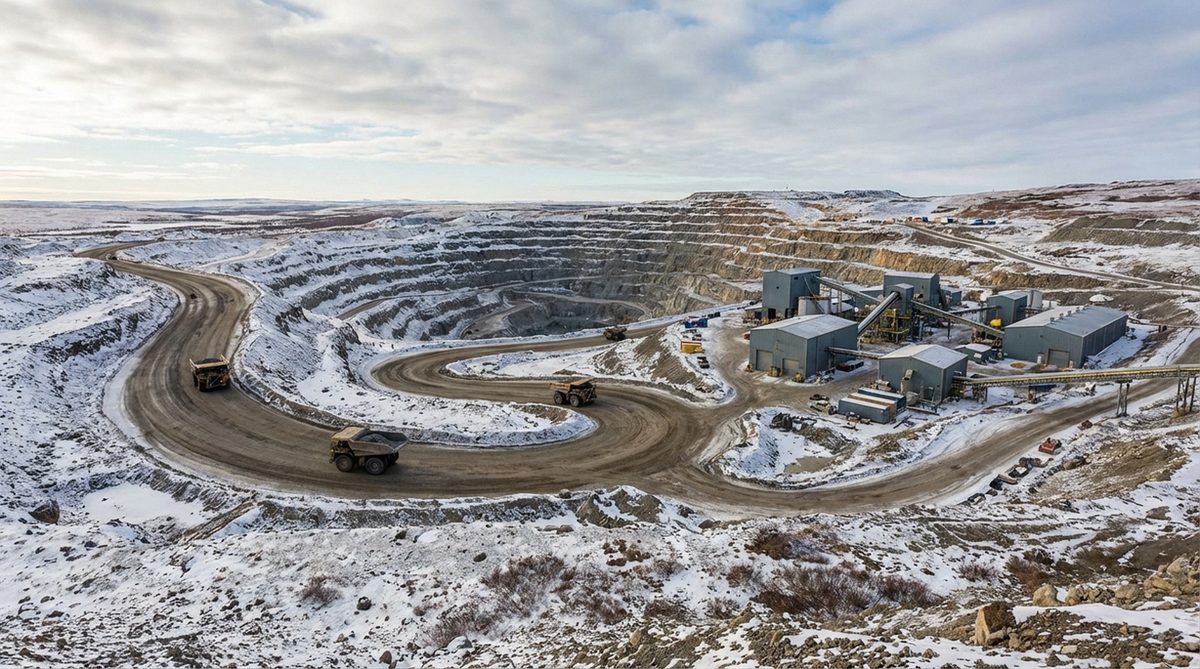
The Discovery That Changed Canadian Mining
The story of the Ekati diamond mine begins not with a corporate boardroom decision, but with the stubborn perseverance of one geologist. Charles "Chuck" Fipke spent more than a decade tracking glacial indicator minerals across the vast Canadian Shield, following a trail of pyrope garnets, chrome diopsides, and other kimberlite indicator minerals that glaciers had scattered hundreds of kilometres from their source. Along with his partner Stewart Blusson, Fipke methodically sampled sediment across northern Canada, gradually narrowing the search area to a remote stretch of tundra near Lac de Gras in the Northwest Territories.
In 1991, the team's persistence paid off. Sampling near a small lake about 310 kilometres northeast of Yellowknife revealed diamondiferous kimberlite — volcanic rock containing diamonds. The discovery triggered the largest staking rush in Canadian mining history, as hundreds of companies scrambled to claim land in the surrounding region. Within weeks, virtually the entire Lac de Gras area had been staked. BHP Billiton (now BHP) partnered with Fipke's company, Dia Met Minerals, to develop the deposit, and after years of environmental assessment and permitting, the Ekati diamond mine officially opened on 14 October 1998.
The name "Ekati" comes from the Tlicho (Dogrib) word for "fat lake," a reference to the area's white quartz rocks that resemble caribou fat. The mine made Canada the world's third-largest diamond producer by value within just a few years of opening, fundamentally reshaping the global diamond industry and proving that commercially viable diamond deposits existed far beyond the traditional African sources.
Location and Access
Ekati sits in one of the most remote mining regions on Earth. Located approximately 310 kilometres northeast of Yellowknife at a latitude of roughly 64.7° N, the mine occupies a landscape of rolling tundra, countless lakes, and exposed Canadian Shield bedrock. The elevation averages around 470 metres above sea level, and winter temperatures routinely plunge below −40°C.
Access to Ekati is limited. Year-round transportation relies on an airstrip capable of handling Hercules C-130 cargo aircraft and Boeing 737 passenger flights that shuttle workers on a two-weeks-on, two-weeks-off rotation. During the brief winter season — typically from late January to late March — the Tibbitt to Contwoyto Winter Road provides a critical surface link. This 400-kilometre seasonal ice road across frozen lakes and tundra allows heavy equipment, fuel, and supplies to be trucked in at a fraction of the cost of air freight. The ice road is one of the longest in the world and serves as a vital logistics artery for all three major diamond mines in the Lac de Gras region.
Ownership History
The Ekati mine has passed through several corporate hands since its inception. Understanding this ownership chain provides context for the mine's operational trajectory:
- 1991–1998: BHP Billiton (80%) and Dia Met Minerals (20%) developed the deposit through exploration, environmental assessment, and construction.
- 1998–2003: BHP Diamonds Inc. operated the mine, with production ramping up through the Panda and Misery open pits.
- 2003–2013: BHP Billiton continued operations, expanding to additional kimberlite pipes including Koala, Fox, and Pigeon.
- 2013: BHP sold its 80% interest to Dominion Diamond Corporation (formerly Harry Winston Diamond Corporation) for approximately CAD $553 million. Dominion already owned the Diavik mine, making it the largest pure-play diamond company listed on a stock exchange at the time.
- 2017: The Washington Companies, owned by American industrialist Dennis Washington, acquired Dominion Diamond in a deal valued at approximately CAD $1.21 billion.
- 2020: Dominion Diamond Mines filed for creditor protection under the Companies' Creditors Arrangement Act (CCAA), citing impacts from the COVID-19 pandemic and challenging diamond market conditions. The mine was temporarily placed into care and maintenance.
- 2021–present: The mine emerged from creditor protection under new ownership as Arctic Canadian Diamond Company, which has been evaluating the feasibility of continued operations and future development projects.
Geological Overview: Kimberlite Pipes at Ekati
The Ekati property encompasses a vast mineral claim block in the Lac de Gras kimberlite field, one of the richest diamond-bearing regions ever discovered. The property contains over 150 known kimberlite pipes, though only a small number have proven to be economically viable for mining. Kimberlite is an igneous rock formed deep in the Earth's mantle — typically at depths of 150 to 450 kilometres — and brought to the surface through violent volcanic eruptions. These pipes act as natural elevators, carrying diamonds from the high-pressure, high-temperature conditions of the mantle to the Earth's surface.
The key kimberlite pipes that have been mined or evaluated at Ekati include:
| Pipe Name | Mining Method | Status | Notable Characteristics |
|---|---|---|---|
| Panda | Open pit, then underground | Depleted | First pipe mined; high-value stones averaging US$120+/carat |
| Misery | Open pit | Depleted (pushback completed) | Larger average stone size; lower value per carat than Panda |
| Koala / Koala North | Open pit, then underground | Depleted | Yielded consistent gem-quality production |
| Fox | Open pit | Depleted | One of the larger pits; moderate grade |
| Pigeon | Open pit | Depleted | Smaller pipe; mined in the mid-2000s |
| Sable | Open pit, then underground | Mined / stockpile processing | Higher-grade pipe; supported later production years |
| Lynx | Open pit | Evaluated | Smaller satellite pipe near main operations |
| Jay | Underground (proposed) | Development uncertain | Largest remaining resource; located beneath Lac de Gras. Contains estimated 30+ million carats |
The kimberlites in the Lac de Gras region are Eocene to Cretaceous in age, ranging from approximately 45 to 75 million years old. However, the diamonds themselves are far older — most are estimated to be between 1.5 and 3.5 billion years old, formed in the ancient lithospheric mantle beneath the Slave Craton, one of the oldest geological formations on Earth.
Production History and Output
Since commencing production in 1998, Ekati has been a significant contributor to Canada's diamond output and the global rough diamond supply. The mine's production has fluctuated considerably based on which pipes were being mined, ore grade, diamond prices, and operational decisions.
| Period | Annual Output (Million Carats, Approx.) | Primary Pipes Mined | Notes |
|---|---|---|---|
| 1998–2000 | 2.5 – 3.5 | Panda (open pit) | Ramp-up phase; high-value initial production |
| 2001–2004 | 3.5 – 5.0 | Panda, Misery, Koala | Multiple pits operating simultaneously; peak efficiency |
| 2005–2008 | 4.0 – 5.5 | Koala, Fox, Pigeon, Panda UG | Transition to underground at Panda; Fox open pit active |
| 2009–2012 | 2.5 – 4.0 | Koala UG, Misery pushback, Sable | Global financial crisis reduced output in 2009; recovery followed |
| 2013–2016 | 3.0 – 4.5 | Misery, Sable, Koala UG | Dominion Diamond ownership era |
| 2017–2019 | 2.0 – 3.5 | Sable, Misery pushback | Washington Companies ownership; ore reserves declining |
| 2020–2021 | Intermittent / suspended | Stockpile processing | COVID-19 shutdown and CCAA proceedings |
| 2022–present | Variable | Sable, stockpile, evaluation | Arctic Canadian Diamond Company; future plans under review |
Over its operational lifetime, Ekati has produced an estimated 67+ million carats of rough diamonds, with a cumulative value exceeding CAD $9 billion. The mine's average diamond value has varied significantly by pipe, ranging from under US$50 per carat for some Misery production to over US$120 per carat for Panda stones. Overall, the mine has maintained an average value of roughly US$100–130 per carat across all production, though this figure has shifted with market conditions and the mix of pipes being processed.
Processing and Recovery
Diamond recovery at Ekati follows a multi-stage process designed to liberate diamonds from the host kimberlite rock while minimising damage to the stones. After kimberlite ore is extracted from the pit or underground workings, it is transported to the processing plant where it undergoes crushing, scrubbing, and dense media separation (DMS). The DMS process exploits the fact that diamonds are denser than most kimberlite minerals, allowing them to be concentrated in a heavy media bath.
The concentrated material then passes through X-ray fluorescence (XRF) and X-ray transmission (XRT) sorting machines, which detect diamonds based on their unique luminescence properties under X-ray exposure. Final hand-sorting by trained technicians ensures that all diamonds above a minimum size threshold are recovered. The entire process is conducted under strict security protocols, including surveillance cameras, biometric access controls, and regular audits.
Employment and Indigenous Community Impact
The Ekati mine has been a major employer in the Northwest Territories throughout its operational history. At peak production, the mine employed approximately 1,500 workers directly, with additional indirect employment generated through service contracts, transportation, and supply chain activities. The mine operates on a fly-in, fly-out rotation — typically two weeks on-site followed by two weeks off — with workers drawn from Yellowknife, communities across the NWT, and southern Canada.
Indigenous participation has been a defining feature of Ekati's social license. The mine holds Impact and Benefit Agreements (IBAs) with four Indigenous groups:
- Tlicho Government (formerly Dogrib Treaty 11 Council)
- Yellowknives Dene First Nation
- Lutsel K'e Dene First Nation
- Kitikmeot Inuit Association
These agreements have provided hundreds of millions of dollars in wages, contracts, scholarships, and community payments over the mine's lifetime. Northern and Indigenous residents have historically comprised 25–30% of the workforce, and Northern businesses have received billions of dollars in procurement contracts. The mine also funds training and apprenticeship programs designed to build long-term skills capacity in Northern communities — a legacy that extends beyond the mine's operational life.
Environmental Management and Reclamation
Operating a large-scale open-pit and underground mine in the Arctic brings significant environmental responsibilities. Ekati's environmental management program addresses water quality, wildlife protection, air quality, and progressive land reclamation under the oversight of the Wek'eezhii Land and Water Board, the Government of the Northwest Territories, and federal regulators.
Key environmental considerations include:
- Water management: The mine manages water through a comprehensive system of containment ponds, treatment facilities, and monitoring stations. Processed water is treated to meet strict discharge standards before release into the surrounding watershed. The Long Lake Containment Facility holds processed kimberlite tailings.
- Wildlife protection: The Bathurst caribou herd migrates through the Ekati region, and the mine maintains monitoring programs, seasonal restrictions, and traffic management protocols to minimise disturbance to caribou and other wildlife including grizzly bears, wolverines, and raptors.
- Progressive reclamation: As individual pits are depleted, they are either allowed to fill with water to form pit lakes or are backfilled with processed kimberlite and waste rock. The mine's Interim Closure and Reclamation Plan outlines strategies for restoring the landscape to a self-sustaining ecosystem after mining concludes.
- Climate considerations: Operating in a permafrost environment means that infrastructure must be designed to account for seasonal freeze-thaw cycles and potential permafrost degradation due to climate change.
Reclamation milestone: The Panda pit, Ekati's first mining area, was one of the earliest Canadian diamond pits to enter the reclamation phase. The pit has been allowed to flood naturally, forming a pit lake that will eventually integrate with the surrounding watershed. Monitoring data collected over several years informs reclamation strategies for the remaining pits and provides valuable precedent for the broader Canadian mining industry.
Current Status and Future Outlook
As of 2025, the Ekati mine's future remains in a state of evaluation. After emerging from creditor protection under the Arctic Canadian Diamond Company banner, the operation has focused on processing stockpiled kimberlite and assessing the economic viability of remaining resources. The most significant undeveloped resource on the property is the Jay kimberlite pipe, which lies beneath Lac de Gras and is estimated to contain more than 30 million carats of diamonds.
Developing Jay would require constructing dikes to hold back lake water and mining the pipe using underground methods — a substantial capital investment. The feasibility of this project hinges on long-term diamond price forecasts, regulatory approvals, and the availability of financing. Other smaller pipes on the property, including Lynx and satellite deposits, also represent potential resources but are at earlier stages of evaluation.
Regardless of the mine's future production timeline, Ekati's legacy is secure. It proved that world-class diamond deposits existed in Canada's North, launched an industry that has contributed tens of billions of dollars to the Canadian economy, and demonstrated that resource development and Indigenous community engagement can operate in tandem. For the Northwest Territories, the diamond industry that Ekati pioneered has become a foundational pillar of the territorial economy — alongside the neighbouring Diavik and Gahcho Kué mines.
Explore all of Canada's diamond mining operations on our interactive mines map, or read the full Canadian diamond industry report for production data and economic analysis across all active mines.
Frequently Asked Questions About the Ekati Diamond Mine
When did the Ekati diamond mine open?
The Ekati diamond mine opened in October 1998, becoming Canada's first commercial diamond mine. It was developed by BHP Billiton (now BHP) after geologists Chuck Fipke and Stewart Blusson discovered diamondiferous kimberlite pipes in the Lac de Gras region of the Northwest Territories in 1991.
Who owns the Ekati diamond mine?
The Ekati diamond mine is currently owned by Arctic Canadian Diamond Company (formerly Dominion Diamond Mines). The mine has changed hands multiple times since BHP originally developed it. BHP sold its stake to Dominion Diamond in 2013, and the mine later went through a restructuring process under creditor protection before emerging under the Arctic Canadian Diamond Company name.
Where is the Ekati diamond mine located?
Ekati is located approximately 310 kilometres northeast of Yellowknife in the Northwest Territories, Canada. The mine sits in the Lac de Gras region of the Canadian Arctic tundra, at an elevation of about 470 metres above sea level. It is accessible only by air year-round and by a seasonal ice road (the Tibbitt to Contwoyto Winter Road) during the winter months.
How many carats has Ekati produced?
Since opening in 1998, the Ekati diamond mine has produced over 67 million carats of rough diamonds. Annual production has varied significantly depending on which kimberlite pipes were being mined and market conditions. Peak production exceeded 5 million carats per year during the mid-2000s, though output has fluctuated in subsequent years due to mine plan adjustments and temporary suspensions.
How many kimberlite pipes does Ekati have?
The Ekati property contains over 150 known kimberlite pipes, though only a fraction of these are economically viable for mining. Key pipes that have been mined or assessed include Panda, Misery, Fox, Koala, Koala North, Pigeon, Sable, Lynx, and Jay. The Jay pipe, located beneath Lac de Gras, represented a significant underground expansion project and contains some of the highest-grade kimberlite on the property.
What is the environmental impact of the Ekati mine?
The Ekati mine operates under strict environmental regulations enforced by the Government of the Northwest Territories and the federal government. Environmental management includes water quality monitoring, wildlife habitat protection (particularly caribou migration routes), progressive reclamation of mined-out pits, and dust and noise control. The mine's Interim Closure and Reclamation Plan outlines long-term strategies for restoring the landscape after mining concludes.
How does Ekati benefit Indigenous communities?
Ekati has Impact and Benefit Agreements (IBAs) with four Indigenous groups: the Tlicho Government, Yellowknives Dene First Nation, Lutsel K'e Dene First Nation, and Kitikmeot Inuit Association. These agreements provide employment opportunities, business contracts, training programs, scholarships, and financial payments. Approximately 25–30% of the mine's workforce has historically been composed of Northern residents, with a significant proportion being Indigenous employees.
Is the Ekati mine still operating?
The Ekati mine has experienced periods of suspension and restart. After going through creditor protection in 2020, the mine resumed operations under Arctic Canadian Diamond Company. Current operations focus on processing stockpiled kimberlite and evaluating the feasibility of mining remaining pipes. The mine's long-term future depends on diamond market conditions and the viability of underground expansion projects like the Point Lake development.
What kind of diamonds does Ekati produce?
Ekati produces a range of gem-quality and industrial-grade diamonds. The mine is known for producing a good proportion of near-colourless to colourless stones, with many grading in the D to G colour range. Typical production includes a mix of sizes, with an average stone size varying by pipe. The Panda pipe historically produced higher-value stones per carat, while other pipes like Misery yielded larger but lower-grade stones on average.
How did Chuck Fipke discover diamonds at Ekati?
Geologist Chuck Fipke, along with partner Stewart Blusson, spent over a decade tracing glacial indicator minerals — including pyrope garnets, chromites, and chrome diopsides — across the Canadian Shield. By following the mineral trail left by ancient glaciers, Fipke traced the indicators back to their kimberlite source near Lac de Gras. In 1991, the team confirmed the presence of diamondiferous kimberlites, triggering the largest staking rush in Canadian mining history.