An Island Mine in the Arctic
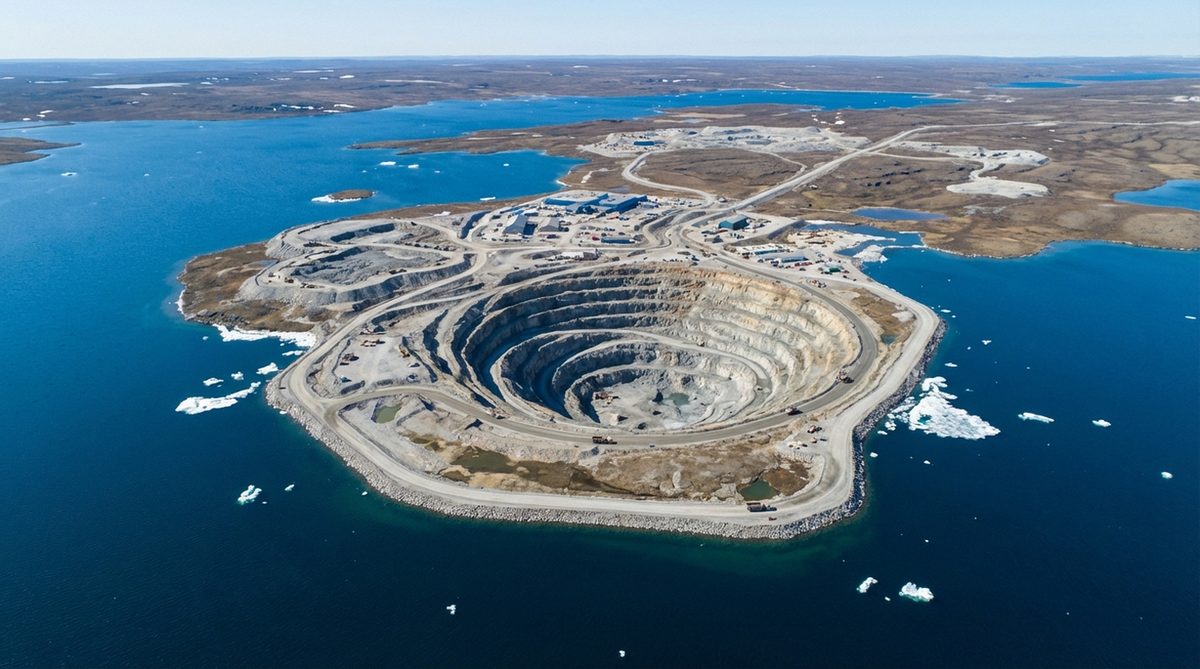
Few diamond mines in the world are as visually striking as Diavik. Situated on a 20-square-kilometre island in Lac de Gras — a large, remote lake approximately 300 kilometres northeast of Yellowknife in the Northwest Territories — the Diavik mine is an engineering marvel set against the stark beauty of the Canadian Arctic. The mine's open pits, carved into the island's bedrock and extending below the surrounding lake level, required the construction of massive dikes to hold back the waters of Lac de Gras, making Diavik one of the most technically challenging mining operations ever undertaken in Canada.
Operated by Rio Tinto, Diavik began production in January 2003 and quickly established itself as one of the most productive and valuable diamond mines on the planet. Over its two-decade operational life, the mine produced an estimated 124 million carats of rough diamonds with a cumulative value exceeding US$18 billion. The mine's high proportion of gem-quality stones — many grading in the colourless to near-colourless range — made Diavik diamonds among the most sought-after in the global market.
With mining operations concluding in 2025, Diavik is now entering its closure and reclamation phase — a carefully planned process that will ultimately return the island to a state compatible with the surrounding environment and traditional land use.
Discovery and Development
The kimberlite pipes at Diavik were discovered during the exploration frenzy that followed Chuck Fipke's landmark discovery at nearby Ekati in 1991. Aber Resources (later renamed Aber Diamond Corporation, and eventually Harry Winston Diamond Corporation and then Dominion Diamond) staked claims on the small island in Lac de Gras and identified four kimberlite pipes through systematic exploration drilling in the mid-1990s.
The development decision was made by Diavik Diamond Mines Inc. — a joint venture between Rio Tinto (60%) and Aber Resources (40%) — following a comprehensive feasibility study and environmental assessment. Construction began in 2001, with the project facing significant logistical challenges: all materials and equipment had to be transported either by air or via the seasonal Tibbitt to Contwoyto Winter Road, and the mine's island location required engineered dikes to allow open-pit mining below the lake surface.
The construction phase employed over 1,600 workers at peak and cost approximately CAD $1.3 billion. The first diamonds were recovered in January 2003, ahead of schedule, and the mine reached full production capacity within its first year of operations.
Kimberlite Pipes and Geology
Diavik's diamond resources are contained within four kimberlite pipes, all located on or immediately adjacent to the small island in Lac de Gras. Each pipe has its own geological characteristics and mining history:
| Pipe | Mining Method | Status | Key Characteristics |
|---|---|---|---|
| A154 South | Open pit, then underground | Completed | Largest and highest-grade pipe; primary production source for most of the mine's life. Underground mining via sub-level retreat began in 2012. |
| A154 North | Underground (accessed via A154 South) | Completed | Smaller pipe adjacent to A154 South; mined as an extension of underground operations. |
| A418 | Open pit, then underground | Completed | Second major production pipe; required a separate dike for open-pit development. Transitioned to underground in the mid-2010s. |
| A21 | Open pit | Completed | Last pipe developed; required construction of a new dike in Lac de Gras. Open-pit mining began in 2018 and provided ore to extend mine life. |
The kimberlite at Diavik is classified as Group 1 kimberlite — the most common type associated with diamond deposits worldwide. The pipes intruded through Archean granite and metasedimentary rocks of the Slave Craton approximately 55 million years ago during the Eocene epoch. The diamonds themselves, however, are far older, having crystallised in the Earth's mantle between 1 and 3.5 billion years ago before being transported to the surface by the kimberlite eruptions.
One of Diavik's geological advantages is the relatively high diamond content per tonne of kimberlite processed. The mine's ore grade has averaged between 2.5 and 4.0 carats per tonne across its various pipes — significantly higher than many other diamond operations globally. Combined with the high average value per carat, this grade made Diavik one of the most economically productive diamond mines in the world on a per-tonne basis.
Production Data and Output
Diavik's production record reflects a mine that consistently delivered high volumes of valuable rough diamonds across more than two decades of operations:
| Period | Annual Output (Million Carats, Approx.) | Primary Sources | Notes |
|---|---|---|---|
| 2003–2005 | 5.0 – 7.5 | A154 South (open pit) | Ramp-up to full production; exceeding initial forecasts |
| 2006–2009 | 8.0 – 11.0 | A154 South, A418 (open pits) | Peak production years; both major pipes in open-pit phase |
| 2010–2013 | 6.0 – 8.5 | A154 South (pit + UG transition), A418 | Underground transition at A154 South; sustained high output |
| 2014–2017 | 5.5 – 7.0 | A154 South UG, A418 (pit + UG), A21 development | Shift to underground methods; A21 dike construction underway |
| 2018–2021 | 5.0 – 7.5 | A154 UG, A418 UG, A21 (open pit) | A21 open pit provides additional ore; COVID-19 caused temporary 2020 suspension |
| 2022–2025 | 3.5 – 6.0 (declining) | A154 UG, A21 residual, stockpile | Final production years; winding down toward closure |
Diavik's lifetime production of approximately 124 million carats places it among the top-producing diamond mines globally. The average value of Diavik diamonds has ranged from US$100 to over US$200 per carat depending on market conditions and the mix of ore processed, with peak per-carat values recorded during the strong diamond market of 2011 and again in 2022. Notably, Diavik has produced several exceptional stones over its lifetime, including rough diamonds exceeding 100 carats — rare finds that generate significant attention in the international diamond trade.
The Diavik Wind Farm: Arctic Renewable Energy
In September 2012, Diavik commissioned a 9.2-megawatt wind farm — one of the most northerly large-scale wind energy installations in the world. The project consists of four Enercon E-70 wind turbines, each with a rated capacity of 2.3 megawatts, specifically engineered for Arctic conditions including extreme cold, high winds, and ice buildup.
The wind farm was designed to reduce Diavik's dependence on diesel fuel, which constitutes the mine's primary energy source and must be transported in via the winter road at considerable cost. At full capacity, the turbines offset approximately 10% of the mine's total energy consumption and reduce diesel usage by an estimated 3.8 million litres per year, cutting annual CO2 emissions by roughly 12,000 tonnes.
Arctic engineering feat: The Diavik wind turbines were designed to operate in temperatures as low as −40°C and withstand wind gusts exceeding 200 km/h. Special cold-weather packages included heated nacelles, ice-resistant blade coatings, and modified lubricants. The project demonstrated the viability of renewable energy in some of the world's harshest operating environments and has been studied as a model for other remote northern mining operations.
Rio Tinto Ownership and Operations
Rio Tinto has been the operator of the Diavik mine since its inception. As one of the world's largest mining companies, Rio Tinto brought substantial capital, technical expertise, and operational systems to the Diavik project. The company's diamonds division managed Diavik alongside its other diamond operations, including the Argyle mine in Western Australia (which closed in 2020 after nearly four decades of production).
The ownership structure of Diavik evolved over the mine's life. Originally a 60/40 joint venture between Rio Tinto and Aber Resources, the minority stake changed hands as Aber was renamed Harry Winston Diamond Corporation (2007) and then Dominion Diamond Corporation (2013). When Dominion entered creditor protection in 2020, Rio Tinto acquired the remaining 40% interest in 2021, becoming the sole owner of the mine for its final years of production and the closure process.
Rio Tinto's operational management of Diavik has been characterised by a strong emphasis on safety performance, environmental compliance, and community engagement. The mine has received multiple industry awards for safety and has maintained rigorous environmental monitoring programs throughout its operational life.
Employment, Training, and Northern Participation
At peak operations, Diavik employed approximately 1,100 to 1,200 workers, with roughly 700 present on-site at any given time. The mine operates on a fly-in, fly-out rotation, with most workers spending two weeks at the mine followed by two weeks at home. A dedicated camp facility on the island provides accommodation, dining, recreation, and medical services.
Northern participation in the Diavik workforce has been a central pillar of the mine's social commitments. Approximately 50% of Diavik's employees have been Northern residents, with Indigenous workers representing a significant and growing share of the workforce. Rio Tinto has invested in training programs, apprenticeships, and partnerships with Northern educational institutions to build skills and capacity in local communities. These investments have created a skilled workforce that extends well beyond diamond mining, with former Diavik employees working across the Northern economy in construction, heavy equipment operation, environmental monitoring, and other fields.
The mine holds participation agreements with five Indigenous communities and organisations, ensuring that economic benefits flow to the communities most directly affected by mining operations. Over the mine's lifetime, billions of dollars in contracts have been awarded to Northern and Indigenous-owned businesses for services ranging from catering and camp management to equipment maintenance and environmental consulting.
Closure and Reclamation
With diamond production concluding in 2025, Diavik is entering one of the most closely watched mine closure processes in Canadian history. The closure plan, developed in consultation with Indigenous communities, regulators, and environmental experts, is expected to take approximately 10 years or more to complete and involves multiple complex phases:
- Infrastructure removal: All surface buildings, processing equipment, and non-essential infrastructure will be dismantled and removed from the site. Materials will be recycled where possible and hazardous materials disposed of at approved facilities.
- Dike management: The engineered dikes that held back Lac de Gras water to enable open-pit mining will be breached in a controlled manner, allowing the lake to refill the pits over time. This process will be carefully monitored to ensure water quality standards are maintained.
- Processed kimberlite containment: The Processed Kimberlite Containment (PKC) facility, which holds tailings from the ore processing plant, will be stabilised and capped. Long-term monitoring will ensure that any seepage meets water quality standards.
- Waste rock management: Waste rock piles will be reshaped and covered to promote revegetation and minimise acid rock drainage. Some waste rock has already been used for construction during the operational phase, reducing the volume requiring management at closure.
- Long-term monitoring: Rio Tinto has committed to multi-decade environmental monitoring of water quality, wildlife activity, vegetation recovery, and permafrost stability at the Diavik site. Monitoring data will be shared with Indigenous communities and regulators.
Rio Tinto has allocated over CAD $1 billion to the Diavik closure fund, making it one of the largest mine reclamation commitments in Canadian history. The closure plan is designed to return the island to a condition that supports traditional land use, wildlife habitat, and a self-sustaining ecosystem — a goal that reflects both regulatory requirements and the expectations of the Indigenous communities who have inhabited this landscape for millennia.
Legacy beyond mining: Diavik's closure process is being studied as a benchmark for responsible mine reclamation in Arctic environments. The environmental data collected over the mine's lifetime — including baseline studies conducted before mining began — provides an invaluable scientific resource for understanding how northern ecosystems respond to, and recover from, industrial activity. This knowledge will inform reclamation planning for future mining projects across Canada's North.
Diavik's Place in Canadian Diamond History
Diavik occupies a unique position in the story of Canadian diamond mining. As the second major diamond mine to open in the Northwest Territories — five years after Ekati — Diavik confirmed that the Lac de Gras region was not a one-mine anomaly but a world-class diamond district. Together with Ekati and the later Gahcho Kué mine, Diavik helped establish Canada as a consistent top-five global diamond producer by both volume and value.
The mine's island setting made it one of the most photographed and recognisable mines in the world, with aerial images of its open pits surrounded by the deep blue waters of Lac de Gras featured in countless documentaries, publications, and educational materials. Beyond its visual impact, Diavik's operational innovations — including the Arctic wind farm, the engineered dikes, and the progressive reclamation program — have set standards that influence mining practice globally.
For the communities of the Northwest Territories, Diavik has been a transformative economic force. The mine has contributed billions of dollars in wages, taxes, royalties, and procurement spending to the territorial and national economies, while its training and employment programs have built human capital that will serve Northern communities long after the last diamond has been recovered.
Learn more about Canada's diamond mining landscape on our interactive mines map, or explore the full scope of the industry in our Canadian diamond industry report.
Frequently Asked Questions About the Diavik Diamond Mine
Where is the Diavik diamond mine located?
The Diavik diamond mine is located on a 20-square-kilometre island in Lac de Gras, approximately 300 kilometres northeast of Yellowknife in the Northwest Territories, Canada. The mine sits at a latitude of about 64.5° N in the Canadian Arctic, within the same kimberlite-rich geological region as the Ekati mine. It is accessible year-round by air and seasonally via the Tibbitt to Contwoyto Winter Road.
Who owns the Diavik diamond mine?
Rio Tinto owns a 100% interest in the Diavik diamond mine. Originally a joint venture with 60% held by Rio Tinto (through its subsidiary Diavik Diamond Mines Inc.) and 40% held by Dominion Diamond Mines, Rio Tinto acquired the remaining 40% stake in 2021 after Dominion entered creditor protection. Rio Tinto has operated the mine since it opened in 2003.
When did the Diavik mine open and when will it close?
The Diavik diamond mine began production in January 2003. The mine was originally expected to operate for approximately 20 years, with closure initially targeted for the early 2020s. However, the discovery of additional resources and the transition to underground mining extended the mine life. Final diamond production concluded in 2025, and the site is now transitioning into its closure and reclamation phase, which is expected to take several years to complete.
How many carats has Diavik produced?
Over its operational lifetime from 2003 to 2025, the Diavik diamond mine produced approximately 124 million carats of rough diamonds. Annual production peaked at over 10 million carats in certain years when multiple kimberlite pipes were being processed simultaneously. The cumulative value of Diavik's production is estimated at over US$18 billion, making it one of the most valuable diamond mines in history.
What kimberlite pipes are at Diavik?
Diavik has four known kimberlite pipes: A154 South, A154 North, A418, and A21. The A154 South pipe was the first to be mined via open pit and later transitioned to underground mining. A418 was mined using both open-pit and underground methods. A21 was the last pipe developed, requiring the construction of a dike in Lac de Gras to enable open-pit mining. A154 North is a smaller pipe adjacent to A154 South.
What is the Diavik wind farm?
In 2012, Diavik commissioned a 9.2-megawatt wind farm consisting of four Enercon E-70 turbines, making it one of the most northerly wind energy installations in the world. The wind farm was designed to reduce the mine's reliance on diesel fuel, which must be trucked in via the seasonal winter road. At full capacity, the turbines offset approximately 10% of the mine's energy needs and reduce diesel consumption by an estimated 3.8 million litres per year, cutting CO2 emissions by roughly 12,000 tonnes annually.
How deep are the Diavik mine pits?
The open pits at Diavik reached depths of approximately 200 to 240 metres below the original surface level. The underground workings extend significantly deeper, with mining conducted to depths exceeding 350 metres below surface. The A154 South underground mine used sub-level retreat mining methods, accessing ore through a series of decline ramps and underground infrastructure built within the kimberlite pipe itself.
What happens to Diavik after closure?
After mining concludes, Diavik will undergo an extensive closure and reclamation process expected to last 10 or more years. The key steps include removing all surface infrastructure, stabilising waste rock and tailings storage areas, breaching the dikes to allow Lac de Gras water to refill the open pits, and long-term water quality and environmental monitoring. Rio Tinto has committed over CAD $1 billion to the closure fund. The goal is to return the site to a state that supports self-sustaining ecosystems and is safe for wildlife and traditional land use.
How many people work at the Diavik mine?
At peak operations, the Diavik mine employed approximately 1,100 to 1,200 workers, with roughly 700 on-site at any given time on a two-weeks-on, two-weeks-off rotation. Northern residents comprised approximately 50% of the workforce, with Indigenous employees representing a significant portion. The mine also generated substantial indirect employment through contractors, suppliers, and service providers across the Northwest Territories and beyond.
What makes Diavik diamonds special?
Diavik diamonds are known for their exceptional quality. An unusually high proportion of the mine's output is gem-quality, with many stones grading in the colourless to near-colourless range (D to H on the GIA colour scale). Diavik has produced some notably large and valuable stones, including several diamonds exceeding 100 carats in the rough. The mine's diamonds carry the "Canadamark" hallmark when sold through authorised channels, providing consumers with verified Canadian origin and ethical sourcing credentials.