Diamond Mining in Canada's Arctic
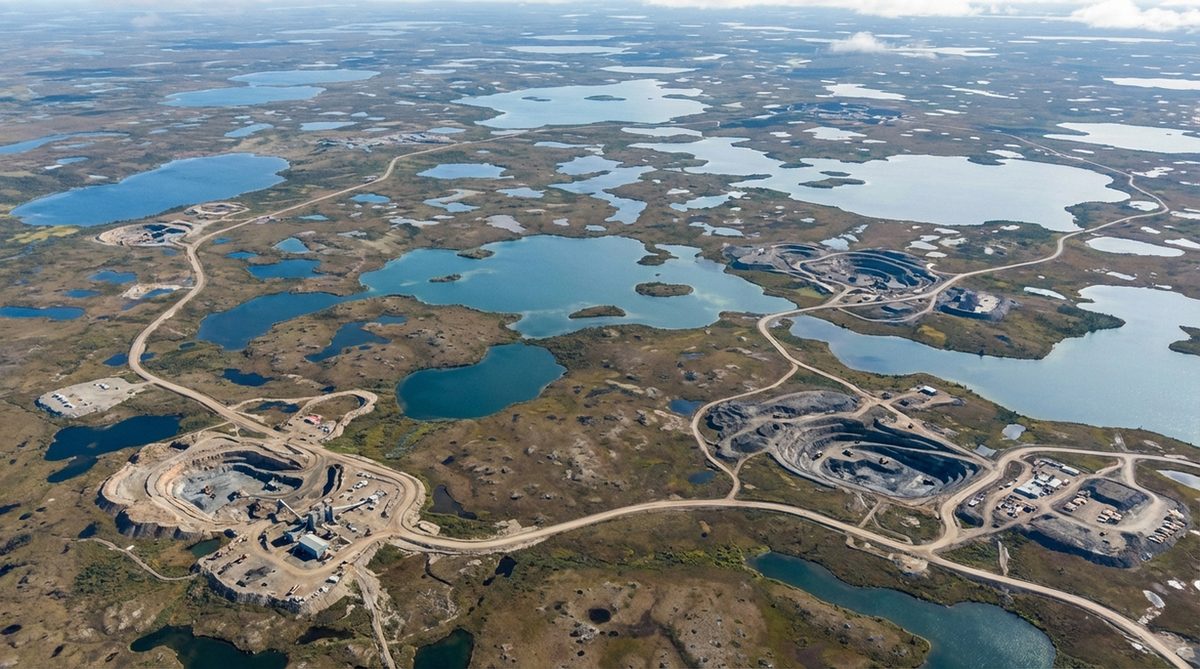
Canada's diamond mining industry is concentrated in one of the most inhospitable environments on Earth: the barren tundra of the Northwest Territories, roughly 200 to 300 kilometres northeast of Yellowknife. Here, in the Lac de Gras region, ancient kimberlite pipes pushed diamond-bearing rock from depths of 150 kilometres or more to the surface over a billion years ago. The discovery of these pipes in 1991 by geologists Chuck Fipke and Stewart Blusson transformed Canada from a country with zero diamond production into one of the world's top five producers within a decade.
The climate around Lac de Gras is extreme. Winter temperatures regularly drop below −40°C, the ground is permafrost, and the only land access is via seasonal ice roads open for roughly eight weeks each year. Despite these challenges, three major mines have operated in this region — Ekati, Diavik, and Gahcho Kué — collectively producing hundreds of millions of carats of rough diamonds since 1998. A fourth mine, Victor, operated in northern Ontario from 2008 to 2019, making it the only significant diamond operation outside the NWT.
Each mine has its own geological character, ownership history, and production profile. Below, we profile all three active and recently closed NWT operations in detail, with links to comprehensive individual pages covering everything from kimberlite pipe geology to employment and environmental reclamation.
Ekati Diamond Mine — Canada's First
| Owner | Arctic Canadian Diamond Company (formerly Dominion Diamond) |
|---|---|
| Opened | October 1998 |
| Status | Active — care & maintenance periods in 2020 and 2024 |
| Location | ~310 km NE of Yellowknife, NWT |
| Cumulative Production | ~70 million carats (1998–2025) |
| Peak Annual Output | ~5.1 million carats (2006) |
Ekati holds the distinction of being Canada's first commercial diamond mine. Developed by BHP Billiton following the Fipke-Blusson discovery, the mine began production in October 1998 and triggered an economic transformation across the Northwest Territories. The operation sits on the claim block where indicator minerals were first identified, covering more than 150 kimberlite pipes — though only a handful have proven economically viable.
Over its lifetime, Ekati has employed both open-pit and underground mining techniques. Several pipes, including Panda, Koala, Fox, and Misery, have been mined in sequence. The mine's ownership has changed hands multiple times — from BHP to Dominion Diamond Mines (acquired in 2017 by The Washington Companies) to its current operator, Arctic Canadian Diamond Company, which emerged from Dominion's insolvency proceedings in 2021.
Ekati's diamonds are known for a relatively high proportion of gem-quality stones, with many grading in the colourless to near-colourless range. The mine has faced intermittent shutdowns for economic reasons, but its remaining ore reserves — particularly in the Sable and Point Lake pipes — are expected to sustain production into the 2030s.
Diavik Diamond Mine — Two Decades of Production
| Owner | Rio Tinto (60%) / Dominion Diamond (40%) |
|---|---|
| Opened | January 2003 |
| Status | Active — closure expected 2026 |
| Location | ~300 km NE of Yellowknife, NWT (East Island, Lac de Gras) |
| Cumulative Production | ~124 million carats (2003–2025) |
| Peak Annual Output | ~10.2 million carats (2013) |
Located on a 20-square-kilometre island in Lac de Gras, Diavik is operated by Rio Tinto and has been Canada's most prolific diamond mine by volume. Since its opening in 2003, Diavik has produced over 124 million carats of rough diamonds from four kimberlite pipes — A154 South, A154 North, A418, and A21. The mine is notable for its engineering: massive dikes were constructed to hold back lake water, allowing open-pit mining of pipes that extend beneath Lac de Gras.
Diavik transitioned fully to underground mining in 2012, accessing deeper ore through a network of tunnels and shafts. The mine has been a major employer in the NWT, with a workforce of approximately 1,100 people at peak operations, and has contributed billions of dollars in wages, taxes, and business contracts to northern communities and Indigenous groups under impact-benefit agreements.
With ore reserves nearing depletion, Rio Tinto has confirmed that Diavik will cease mining operations in 2026. A comprehensive closure plan, including the flooding of open pits, removal of infrastructure, and long-term environmental monitoring, is already underway. The wind farm installed in 2012 — the first at a Canadian diamond mine — reduced diesel consumption by approximately 10% during the mine's later years.
Gahcho Kué Diamond Mine — Canada's Newest Producer
| Owner | De Beers Canada (51%) / Mountain Province Diamonds (49%) |
|---|---|
| Opened | September 2016 |
| Status | Active — mine life estimated to 2030 |
| Location | ~280 km NE of Yellowknife, NWT |
| Cumulative Production | ~42 million carats (2016–2025) |
| Peak Annual Output | ~6.9 million carats (2020) |
Gahcho Kué is the most recently opened diamond mine in Canada and the largest new open-pit diamond mine to launch globally in over a decade. Jointly owned by De Beers Canada and Mountain Province Diamonds, the mine is located at Kennady Lake, about 280 kilometres northeast of Yellowknife. The name "Gahcho Kué" comes from the Chipewyan Dene language, meaning "place of the big rabbit."
The mine extracts diamonds from three kimberlite pipes — 5034, Hearne, and Tuzo — using conventional open-pit methods. Kennady Lake was partially dewatered to access the pipes, a process that required careful environmental management and approval from federal and territorial regulators. Gahcho Kué's diamonds tend to be smaller in average carat weight than those from Ekati or Diavik but include a notable proportion of higher-quality stones.
De Beers has invested in a sorting and valuation facility at the mine site, and rough diamonds are flown to Yellowknife for further processing before entering De Beers' global supply chain. The mine is expected to operate until approximately 2030, depending on market conditions and potential underground extensions of the Tuzo pipe.
Full Gahcho Kué Mine Profile →
Canadian Diamond Mines — Comparison Table
The following table summarises key data for all four mines that have operated commercially in Canada, including the Victor mine in Ontario, which closed in 2019.
| Mine | Owner | Province/Territory | Opened | Status | Cumulative Carats | Peak Output/Year |
|---|---|---|---|---|---|---|
| Ekati | Arctic Canadian Diamond Co. | NWT | 1998 | Active | ~70M | ~5.1M (2006) |
| Diavik | Rio Tinto | NWT | 2003 | Closing 2026 | ~124M | ~10.2M (2013) |
| Gahcho Kué | De Beers / Mountain Province | NWT | 2016 | Active | ~42M | ~6.9M (2020) |
| Victor | De Beers Canada | Ontario | 2008 | Closed 2019 | ~8M | ~0.8M (2014) |
Combined, these four mines have produced over 240 million carats of rough diamonds, making Canada a significant force in the global diamond industry. For a visual overview of mine locations and kimberlite fields, see our interactive mines map.
Future Diamond Mining Prospects in Canada
With Diavik approaching closure and Ekati's long-term future uncertain, the question of whether new diamond mines will open in Canada is increasingly important. Several advanced exploration projects offer potential, though none is likely to reach production before the end of this decade.
Chidliak (Baffin Island, Nunavut) — De Beers has identified 74 kimberlite pipes at its Chidliak property on southern Baffin Island. Bulk sampling of the CH-6 and CH-7 pipes has returned promising results, and the project is considered one of the most significant diamond exploration assets globally. However, the remote location and lack of infrastructure present major development challenges.
Star-Orion South (Saskatchewan) — Star Diamond Corporation's project near Prince Albert is one of the few Canadian diamond prospects outside the Arctic. The Fort à la Corne kimberlite field contains large, low-grade pipes that could support high-volume processing. Rio Tinto held and then relinquished a joint venture stake, and the project's economics remain under evaluation.
Kennady North (NWT) — Located adjacent to Gahcho Kué, Mountain Province Diamonds' Kennady North project includes the Kelvin and Faraday kimberlite pipes. Early-stage exploration has been encouraging, but significant further work is needed to determine whether a standalone mine is feasible.
Canada's diamond industry faces a transition period as established mines wind down. Whether the next generation of projects can replicate the success of Ekati, Diavik, and Gahcho Kué will depend on diamond prices, technological advances in arctic mining, regulatory timelines, and the evolving relationship between mining companies and Indigenous communities. For a broader look at how Canadian production fits into the global picture, visit our industry report.
Frequently Asked Questions About Canadian Diamond Mines
How many diamond mines are there in Canada?
Canada currently has two active diamond mines: Gahcho Kué (owned by De Beers and Mountain Province Diamonds) and Ekati (owned by Arctic Canadian Diamond Company). The Diavik mine, operated by Rio Tinto, is expected to close in 2026 after more than two decades of production. A fourth mine, Victor in Ontario, operated from 2008 to 2019. All three NWT mines are located within 300 kilometres of each other near Lac de Gras.
Where are Canadian diamond mines located?
Canada's three major diamond mines — Ekati, Diavik, and Gahcho Kué — are all located in the Northwest Territories, approximately 200 to 280 kilometres northeast of Yellowknife near Lac de Gras. The Victor mine, which closed in 2019, was located in northern Ontario near Attawapiskat. All of these mines are in remote, subarctic regions accessible primarily by winter ice roads and aircraft.
Which is the largest diamond mine in Canada?
Ekati is the largest diamond mine in Canada by cumulative production. Since opening in 1998 as Canada's first commercial diamond mine, Ekati has produced over 70 million carats of rough diamonds. In terms of peak annual production, Diavik held the record at approximately 10 million carats per year during its highest-output period between 2010 and 2015.
When did diamond mining start in Canada?
Commercial diamond mining in Canada began in October 1998 when the Ekati mine opened in the Northwest Territories. The discovery that led to Ekati was made in 1991 by geologists Chuck Fipke and Stewart Blusson, who identified diamond-bearing kimberlite pipes near Lac de Gras. This discovery triggered the largest mineral staking rush in Canadian history.
Are Canadian diamond mines open pit or underground?
Canadian diamond mines use both open pit and underground methods. Most mines start as open-pit operations and transition to underground mining as surface ore is depleted. Ekati uses a combination of open pit, underground, and innovative dike-draining techniques for pipes beneath lakes. Diavik similarly transitioned from open pit to underground. Gahcho Kué currently operates primarily as an open-pit mine with three kimberlite pipes.
What happens when a Canadian diamond mine closes?
When a Canadian diamond mine closes, the operator must follow a detailed closure and reclamation plan approved by territorial or provincial regulators. This includes removing infrastructure, recontouring landscapes, managing tailings, restoring water quality in affected lakes, and revegetating disturbed areas. Mine operators are required to post financial security bonds — often in the hundreds of millions of dollars — before mining begins. The Victor mine closure in 2019 and the upcoming Diavik closure provide real-world examples of this process.
How are diamonds transported from remote Canadian mines?
Diamonds mined in the Northwest Territories are sorted on-site and then flown by chartered aircraft to Yellowknife, where they undergo further sorting and valuation. Heavy supplies and fuel are brought to the mines via seasonal winter ice roads — typically open from late January to late March — that cross frozen lakes and tundra. The Tibbitt to Contwoyto Winter Road, at roughly 400 kilometres, is one of the longest ice roads in the world.
Will new diamond mines open in Canada?
Several exploration projects could lead to new Canadian diamond mines. The most advanced is De Beers' Chidliak project on Baffin Island, Nunavut, where 74 kimberlite pipes have been identified. Star Diamond's Star-Orion South project in Saskatchewan and Peregrine Diamonds' DO-27 pipe near Lac de Gras are other prospects. However, developing a new diamond mine in Canada's remote north requires billions in capital investment, lengthy environmental assessments, and Indigenous consultation, meaning any new mine is likely years away from production.