Why Cut Is the Most Important of the 4Cs
Of the four quality factors used to evaluate diamonds — cut, clarity, colour, and carat weight — cut has the greatest influence on a diamond's visual beauty. A perfectly colourless, flawless diamond will look dull and lifeless if it is poorly cut. Conversely, a well-cut diamond with slightly lower colour or clarity grades will dazzle the eye with brilliant flashes of white light and spectral colour.
Cut quality refers to how effectively a diamond's facets interact with light. It encompasses three measurable properties: proportions (the angles and relative measurements of the facets), symmetry (how precisely the facets align and intersect), and polish (the smoothness of each facet surface). Together, these factors determine how much light enters the diamond, how it bounces within the stone, and how it exits back to the viewer's eye.
For Canadian diamond buyers, understanding cut is especially important. Rough diamonds mined in the Northwest Territories — from operations like Ekati, Diavik, and Gahcho Kué — are among the finest crystals in the world. But even exceptional rough can produce a mediocre gem if the cutter prioritises weight retention over optical performance. Knowing what to look for in a diamond certificate can save you thousands of dollars and ensure your stone truly sparkles.
Understanding Brilliance, Fire, and Scintillation
Three distinct optical phenomena define a diamond's light performance. Each depends directly on cut quality:
- Brilliance
- The total amount of white light reflected from the diamond back to the observer. A well-proportioned diamond acts as a highly efficient mirror, bouncing light that enters through the crown back out through the table and upper facets. Diamonds cut too shallow allow light to leak through the bottom; diamonds cut too deep lose light through the sides.
- Fire
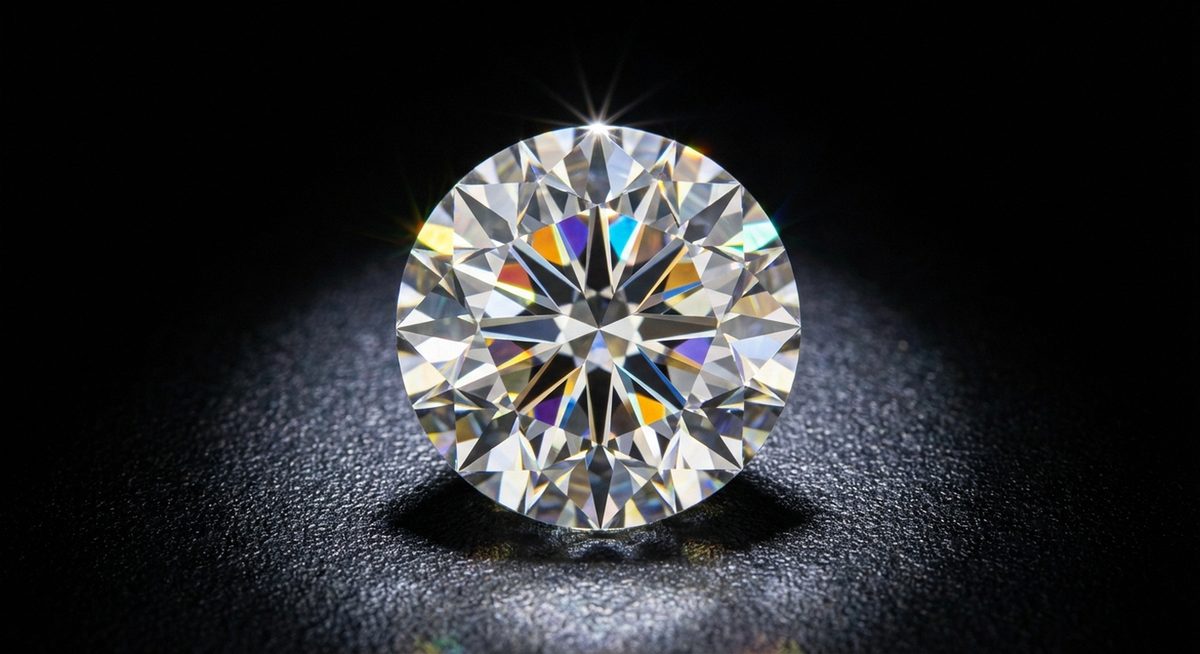
- The dispersion of white light into its spectral components — flashes of red, orange, blue, green, and violet visible as the diamond moves. Fire occurs when light is refracted at the correct angles, separating wavelengths. Crown angle is the primary factor controlling fire: steeper crowns produce more dispersion, while flatter crowns reduce it.
- Scintillation
- The pattern of bright and dark areas seen when the diamond, the light source, or the observer moves. Good scintillation produces a lively, sparkling appearance with a balanced contrast pattern. Poor scintillation results in large, dead zones or a "crushed ice" appearance with no defined sparkle pattern.
The interplay of these three properties creates what jewellers call "life" — the dynamic sparkle that makes diamonds unlike any other gemstone. A diamond graded Excellent for cut maximises all three simultaneously.
Explore Diamond Cut Grades Interactively
Use the interactive tool below to compare how different cut grades affect a diamond's light behaviour. Select a cut grade to see how proportions change and what happens to brilliance and fire.
The GIA Cut Grading Scale for Round Brilliant Diamonds
The Gemological Institute of America (GIA) grades round brilliant diamond cut on a five-tier scale. This system evaluates brightness, fire, scintillation, weight ratio, durability, polish, and symmetry. GIA does not assign cut grades to fancy shapes (princess, oval, cushion, etc.), which makes the round brilliant the only shape with a standardised cut quality assessment.
Excellent
An Excellent cut diamond reflects nearly all light that enters, producing exceptional brilliance and fire. These diamonds exhibit balanced, symmetrical scintillation with no visible light leakage. Proportions fall within a narrow range: table percentage between 54% and 57%, crown angle between 34° and 35°, and pavilion angle between 40.6° and 41°. Approximately 30% of round brilliants on the market receive this grade.
Very Good
Very Good cut diamonds reflect most light, offering strong brilliance and fire that is difficult to distinguish from Excellent in casual viewing. Minor deviations in proportion or symmetry prevent the top grade, but these diamonds represent outstanding value. They typically cost 10–15% less than comparable Excellent cut stones while appearing nearly identical to the untrained eye.
Good
Good cut diamonds reflect a majority of light and display noticeable brilliance, though trained observers can detect some light leakage or reduced fire compared to higher grades. These diamonds may have slightly deeper or shallower proportions. They offer a significant price advantage — often 25–35% below Excellent cut — and are suitable for buyers who want to maximise carat weight on a budget.
Fair
Fair cut diamonds allow a substantial amount of light to escape from the bottom or sides, resulting in noticeably reduced brilliance. These stones may appear dark or glassy in certain lighting conditions. While they carry a low price point, most gemologists advise against Fair cut for engagement rings or other prominent jewellery pieces.
Poor
Poor cut diamonds lose most of their light through the pavilion or sides, producing minimal brilliance and fire. Proportions are significantly outside ideal ranges. These diamonds are rarely stocked by reputable retailers and should be avoided for any purchase where visual beauty is a consideration.
Diamond Cut Grade Comparison
The table below summarises how each GIA cut grade affects light performance, rarity, price, and visual impact for a 1-carat round brilliant diamond.
| Cut Grade | Light Performance | % of Diamonds | Price Premium | Visual Impact |
|---|---|---|---|---|
| Excellent | Maximum brilliance, fire, and scintillation with virtually no light leakage | ~30% | +15–25% vs Very Good | Intense sparkle in all lighting conditions; face-up appearance maximised |
| Very Good | Strong brilliance and fire; minor light leakage only visible under magnification | ~25% | Baseline | Beautiful sparkle; virtually indistinguishable from Excellent in normal viewing |
| Good | Moderate brilliance; some visible light leakage through pavilion or crown | ~25% | −15–25% vs Very Good | Pleasant appearance; sparkle noticeable but less intense than higher grades |
| Fair | Reduced brilliance; significant light loss visible to the unaided eye | ~15% | −30–45% vs Very Good | Flat or dark zones visible; diamond may appear smaller than its carat weight |
| Poor | Minimal light return; most light escapes through bottom and sides | ~5% | −50–65% vs Very Good | Dull, lifeless appearance; significant dark areas visible face-up |
Diamond Proportions Explained: The Anatomy of a Well-Cut Stone
A diamond's proportions are the measurable angles and percentages that define its geometry. Even small deviations from ideal proportions can dramatically alter light behaviour. The following measurements are the most critical:
Table Percentage
The table is the large, flat facet on the top of the diamond. Table percentage is the width of this facet expressed as a percentage of the diamond's total diameter. For round brilliants, the ideal range is 54–57%. A table that is too large reduces fire; a table that is too small reduces brilliance.
Crown Angle
The crown is the upper portion of the diamond between the girdle and the table. Crown angle — measured between the crown facet and the girdle plane — ideally falls between 34° and 35°. Steeper crown angles increase fire but may reduce brilliance. Shallow crowns sacrifice fire for brightness.
Pavilion Angle
The pavilion is the lower portion of the diamond, from the girdle to the culet. Pavilion angle is the single most influential proportion for brilliance. The ideal range for round brilliants is 40.6° to 41°. Even a 0.2° deviation outside this range can cause measurable light loss. Diamonds with pavilion angles above 41.2° tend to show a dark centre; those below 40.4° exhibit a "fisheye" effect where the girdle reflection is visible through the table.
Depth Percentage
Total depth percentage is the diamond's height (from table to culet) divided by its average diameter. The ideal range is 59–62.5%. Diamonds outside this range either carry hidden weight (too deep) or spread too thin (too shallow), affecting both visual size and light performance.
Girdle Thickness
The girdle is the thin band at the widest point of the diamond, separating the crown from the pavilion. It should be rated Thin to Slightly Thick. An extremely thin girdle risks chipping during setting, while an extremely thick girdle adds hidden weight and creates a dark ring visible under the table.
Cut vs. Shape: Why These Terms Are Not Interchangeable
One of the most common points of confusion for diamond buyers is the difference between cut and shape. These terms describe entirely different attributes:
Shape refers to the outline of the diamond when viewed from above. Common diamond shapes include round brilliant, princess (square), oval, cushion, emerald (rectangular step-cut), marquise, pear, asscher, radiant, and heart. Shape is a matter of personal preference and style.
Cut refers to the quality of the faceting work — how precisely the diamond was cut to optimise light performance. A princess-shaped diamond can be cut with Excellent or Poor proportions and symmetry. Cut is a quality assessment that applies to every shape, although the GIA only assigns formal cut grades to round brilliants.
When shopping for fancy-shaped diamonds (anything other than round), you will need to evaluate proportions yourself or rely on vendor recommendations, as there is no universally standardised cut grading system for these shapes. Pay close attention to length-to-width ratios, depth percentages, and the presence of bow-tie effects in elongated shapes like ovals and marquises.
Hearts and Arrows: The Pinnacle of Diamond Cut Precision
Hearts and arrows (H&A) diamonds represent the ultimate in cut precision. When viewed through a special scope, these super-ideal round brilliants display a pattern of eight perfectly symmetrical hearts from the pavilion side and eight arrows from the crown side. This pattern is only possible when every facet is aligned with extreme accuracy — tolerances of less than half a degree.
True H&A diamonds are not a separate GIA grade; they are a subset of Excellent cut stones with superior symmetry. They typically command a 10–20% premium over standard Excellent cut diamonds. For buyers seeking the absolute maximum in optical performance, H&A diamonds deliver measurably higher brightness and contrast.
Not all diamonds labelled "hearts and arrows" meet strict criteria. Some vendors apply the term loosely. Look for diamonds graded by AGS with an Ideal light performance score, or request an H&A image from the vendor to verify the pattern's precision. Learn more about certifying diamond quality in our Canadian diamond certificate guide.
Cut Quality in Canadian Diamonds: What Buyers Should Know
Canada's diamond mines — Ekati, Diavik, and Gahcho Kué in the Northwest Territories — produce rough crystals renowned for their clarity and consistent crystal structure. This high-quality rough has the potential to yield exceptionally well-cut polished stones. However, potential and reality do not always align.
A significant portion of Canadian rough is exported to cutting centres in India, Belgium, and Israel, where market pressures can incentivise cutters to maximise carat weight at the expense of cut quality. A 1.05-carat diamond commands a substantially higher per-carat price than a 0.97-carat stone, so cutters may leave the pavilion slightly deep or the girdle thick to cross the one-carat threshold. The result is a heavier diamond with compromised light performance.
Diamonds cut and polished within Canada — certified with a Government of the Northwest Territories (GNWT) Certificate of Authenticity — are sometimes cut to more conservative proportions as well, because the Canadian certification adds value that the manufacturer wants to preserve at a specific carat weight.
The takeaway for buyers: never assume that a Canadian origin guarantees a superior cut. Always examine the cut grade on the grading certificate, review the proportion diagram, and request images or video where possible. If you are purchasing a diamond over 0.50 carats, an Excellent cut grade should be non-negotiable.
How Diamond Cut Grade Affects Price in the Canadian Market
Cut grade has a profound impact on diamond pricing. Among the 4Cs, cut creates the widest price variance for visually comparable stones. Consider a 1-carat, G-colour, VS2-clarity round brilliant — a popular specification in the Canadian engagement ring market. The approximate price differences by cut grade (in CAD, as of early 2026) illustrate the spread:
- Excellent cut: $8,500–$10,200
- Very Good cut: $7,200–$8,800
- Good cut: $5,800–$7,400
- Fair cut: $4,200–$5,600
The premium for Excellent cut is justified by substantially superior visual performance. In side-by-side comparisons, most observers — even those with no gemological training — can readily distinguish an Excellent cut diamond from a Good cut diamond. The difference in brilliance and fire is that pronounced.
For budget-conscious buyers, Very Good cut offers the best balance of performance and value. The visual difference between Very Good and Excellent is subtle and often undetectable outside laboratory conditions. Use our diamond price calculator to model different specification combinations and find the optimal balance for your budget.
Expert Tip: Always Prioritise Cut
If you need to compromise on any of the 4Cs to stay within budget, reduce colour or clarity before cut. A well-cut H-colour, SI1-clarity diamond will appear more beautiful than a poorly cut D-colour, VVS1-clarity diamond. The cut is what makes the diamond sparkle — without it, even the finest raw material looks ordinary. For round brilliants, insist on Excellent or Very Good. For fancy shapes, study the proportions carefully and request video to assess light performance before purchasing.
Frequently Asked Questions About Diamond Cut Quality
What is the best diamond cut grade?
The GIA Excellent cut grade is the highest available and delivers maximum brilliance, fire, and scintillation. For round brilliant diamonds, an Excellent or Ideal cut ensures the best possible light performance. The AGS equivalent is AGS Ideal (0). If budget allows, always prioritise cut grade over colour or clarity.
What is the difference between diamond cut and shape?
Diamond cut refers to how well a diamond's facets interact with light, encompassing proportions, symmetry, and polish. Diamond shape refers to the outline form, such as round brilliant, princess, oval, or cushion. A round brilliant diamond can have an Excellent or Poor cut grade. Cut is a quality measurement; shape is a style preference.
What are hearts and arrows diamonds?
Hearts and arrows diamonds are super-ideal cut round brilliants that display a pattern of eight symmetrical hearts when viewed from the bottom and eight arrows from the top. This pattern is only visible through a special viewer and indicates exceptional precision in facet alignment. These diamonds typically command a 10–20% premium over standard Excellent cut stones.
Does cut affect diamond size appearance?
Yes. A well-cut diamond appears larger than a poorly cut diamond of the same carat weight. Diamonds cut too deep carry weight in the pavilion where it cannot be seen face-up, resulting in a smaller-looking stone. An Excellent cut 1-carat diamond can appear up to 10% larger face-up than a Poor cut 1-carat diamond.
What is an "ideal" cut diamond?
An ideal cut diamond has proportions that maximise light return. The term originated with Marcel Tolkowsky's 1919 calculations for the round brilliant. Today, the American Gem Society (AGS) uses the term AGS Ideal (grade 0), while GIA's highest grade is Excellent. Both designations indicate top-tier light performance, though AGS Ideal uses a stricter mathematical model for light behaviour.
How much does cut grade affect price?
Cut grade significantly affects diamond pricing. An Excellent cut diamond typically costs 15–25% more than a Very Good cut of the same carat, colour, and clarity. Moving from Good to Excellent can represent a 25–40% price increase. Despite the premium, Excellent cut diamonds offer the best value because they maximise the visual beauty of the stone.
What cut grade should I choose for an engagement ring?
For an engagement ring, choose Excellent or Very Good cut grade. These grades ensure the diamond will sparkle brilliantly in any lighting condition. If budget is tight, reduce colour or clarity before compromising on cut. A well-cut H-colour SI1 diamond will look more beautiful than a poorly cut D-colour VVS1 diamond in everyday viewing.
Can a well-cut diamond hide colour or inclusions?
Yes. A well-cut diamond disperses light so effectively that slight body colour becomes less noticeable, and small inclusions are masked by brilliance and scintillation. This is why gemologists recommend prioritising cut: an Excellent cut G-colour diamond often faces up whiter than a Good cut E-colour diamond. The same principle applies to clarity; intense sparkle distracts the eye from minor inclusions.
What is diamond fire vs brilliance?
Brilliance is the white light reflected from the diamond's surface and interior back to the viewer's eye. Fire is the dispersion of white light into spectral colours — the flashes of red, blue, orange, and green visible as the diamond moves. A third property, scintillation, refers to the pattern of light and dark areas and the sparkle produced when the diamond, light source, or observer moves.
Are Canadian diamonds well cut?
Canadian rough diamonds, particularly from the Northwest Territories mines like Ekati and Diavik, are known for high-quality crystal. However, cut quality depends on the cutting facility, not the origin of the rough. Some Canadian rough is cut domestically to maximise carat retention for certification purposes, which can sometimes compromise cut quality. Always verify the cut grade on the grading certificate regardless of origin.
What is the AGS Ideal cut grade?
The AGS Ideal cut grade (grade 0 on a 0–10 scale) is the highest cut designation from the American Gem Society Laboratories. It uses ray-tracing technology to evaluate light performance, including brightness, fire, and contrast. AGS Ideal is considered slightly more stringent than GIA Excellent for round brilliants because it mathematically models actual light behaviour rather than relying solely on proportion ranges.
Continue Your Diamond Education
Understanding cut is the foundation of smart diamond buying. Explore the rest of the 4Cs and our Canadian diamond resources to become a fully informed buyer:
- Diamond Clarity Guide — learn how inclusions and blemishes affect value
- Diamond Colour Guide — understand the D-to-Z colour grading scale
- Diamond Carat Weight Guide — how size and weight relate to price
- Diamond Prices in Canada — current market pricing and trends
- Diamond Price Calculator — model specifications and estimate costs
- Canadian Diamond Certificates — verify authenticity and grading
- Engagement Ring Guide — choose the perfect setting for your diamond