What Is Diamond Colour and Why Does It Matter?
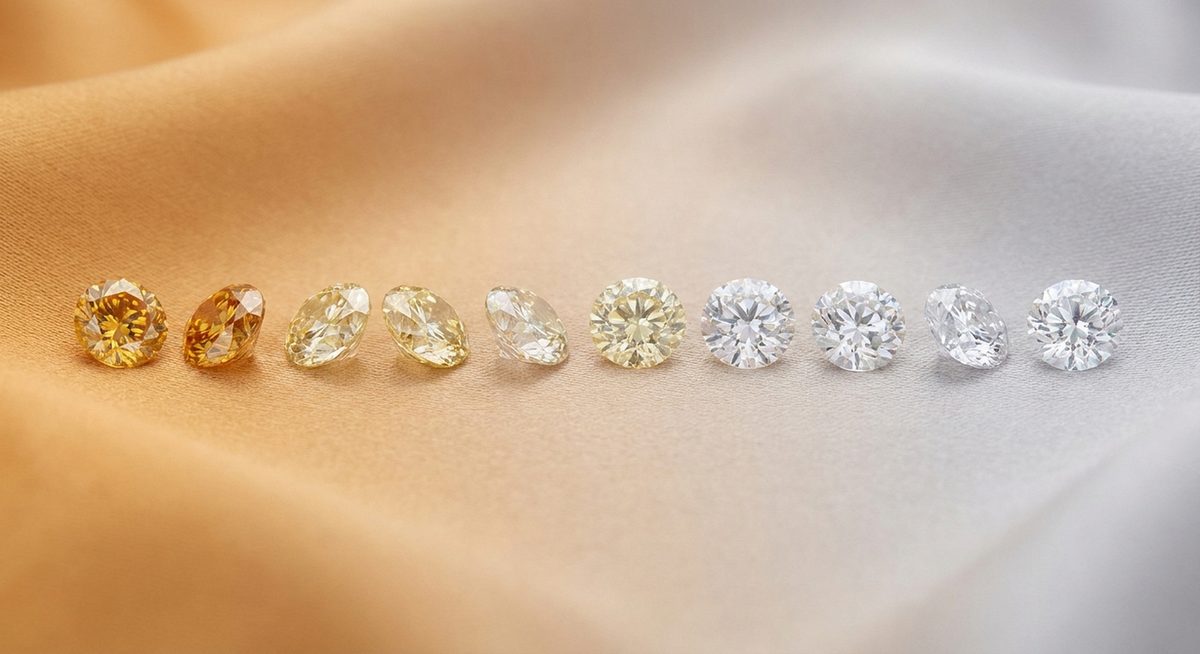
Diamond colour refers to the natural body tint present in a white (or "cape series") diamond. Contrary to what many buyers assume, most gem-quality diamonds are not perfectly transparent. They carry trace amounts of nitrogen atoms within their crystal lattice, and those nitrogen impurities absorb blue light, causing the stone to display a faint yellow or brownish hue. The less nitrogen present, the more colourless the diamond appears — and the higher its colour grade.
Colour is one of the four Cs that determine a diamond's quality and market price, alongside clarity, cut, and carat weight. Of the four, colour is the second most visually noticeable characteristic after cut quality. A well-cut diamond can mask minor colour tinting through its brilliant light return, but a poorly cut stone will expose even slight warmth that might otherwise go unnoticed.
For Canadian buyers, understanding diamond colour is particularly relevant because diamonds mined in the Northwest Territories — from operations like Ekati, Diavik, and Gahcho Kue — frequently grade in the upper colour tiers. The geological conditions beneath the Canadian Shield that produce these stones tend to yield a higher proportion of near-colourless to colourless rough than many other diamond-producing regions worldwide.
The GIA Diamond Colour Scale: D Through Z Explained
The Gemological Institute of America (GIA) established the industry-standard colour grading system in the 1950s, deliberately starting at D to avoid confusion with earlier, inconsistent grading systems that used A, B, and C. The scale runs from D (completely colourless) to Z (light yellow or brown), encompassing 23 individual grades grouped into five categories.
D–F: Colourless
Diamonds graded D, E, or F contain virtually no detectable body colour when viewed under controlled lighting by a trained grader. D-grade diamonds are exceptionally rare — fewer than 1 in 20 gem-quality stones reaches this grade — and they command the highest per-carat premiums. The difference between D, E, and F is subtle enough that even experienced gemologists need master comparison stones to distinguish them reliably. For the consumer, all three grades appear identically white once mounted in jewellery. Canadian mining operations have produced notable D-colour stones, including several significant gems from the Diavik mine that have appeared at international auction.
G–J: Near Colourless
The near-colourless range represents the value sweet spot for most diamond buyers. G and H colour diamonds face up white in any setting metal and are visually indistinguishable from D-F grades without side-by-side comparison under laboratory conditions. I and J grades may show a very faint warm tint when viewed loose against a pure white background, but this trace of warmth typically disappears once the stone is set in a ring. This range accounts for the majority of engagement ring diamonds sold across Canada and offers savings of 20–40% compared to equivalent colourless grades.
K–M: Faint Yellow
Faint-yellow diamonds display a noticeable warm tint that trained observers can detect face-up, though many untrained eyes still perceive them as "white with a hint of warmth." K-M grades pair exceptionally well with yellow gold settings, where the warm metal tone complements and masks the diamond's body colour. These grades offer substantial value, with prices approximately 40–55% below D-colour equivalents. Buyers seeking the largest visual size within a fixed budget often find K-colour diamonds an intelligent choice when set in yellow or rose gold.
N–R: Very Light Yellow or Brown
Diamonds in the N-R range carry a clearly visible yellow or brownish tint. They occupy an awkward middle ground in the market — too tinted to sell as traditional white diamonds but not saturated enough to qualify as fancy-colour yellows. Prices in this range drop considerably, and demand is lower. These grades are less commonly offered in Canadian retail jewellery stores, though they can represent excellent value for buyers who appreciate a warm aesthetic.
S–Z: Light Yellow or Brown
At the low end of the D-to-Z scale, S through Z diamonds display obvious colour that is visible to any observer in any lighting condition. Once a diamond's colour saturation exceeds the Z grade, it enters the Fancy Colour classification, where intense yellow, known in the trade as "canary," commands premium prices once again. The S-Z range is the least commercially popular segment of the standard colour scale.
Explore the Colour Scale Interactively
Use the interactive tool below to compare how different colour grades appear across various settings and lighting conditions. Select a grade to see how the diamond looks in white gold, yellow gold, and under different light sources.
Diamond Colour Grade Comparison: Price, Appearance, and Setting Recommendations
| Grade Range | Category | Appearance | Price Range (1ct, VS2, Excellent Cut) | Recommended Setting |
|---|---|---|---|---|
| D–F | Colourless | No visible body colour; icy white transparency. Indistinguishable face-up without master stones. | CAD $8,500–$13,200 | Platinum or white gold — maximises the colourless investment |
| G–H | Near Colourless (upper) | Faces up white; trace warmth only detectable loose, side-by-side with D-F under lab conditions. | CAD $6,200–$8,400 | Any metal — appears colourless in white gold, platinum, yellow gold, or rose gold |
| I–J | Near Colourless (lower) | Very faint warmth visible when loose; once set, most observers perceive as white. | CAD $4,800–$6,100 | Yellow gold or rose gold preferred; white gold acceptable for round brilliants |
| K–M | Faint Yellow | Warm tint visible face-up under most lighting; distinctly warmer than near-colourless grades. | CAD $3,200–$4,700 | Yellow gold strongly recommended — complements and conceals body colour |
Prices reflect approximate Canadian retail ranges as of early 2026 for 1.00-carat round brilliants with VS2 clarity and GIA Excellent cut grade. Actual prices vary by retailer, certification lab, and individual stone characteristics. Use our Diamond Price Calculator for more specific estimates.
How Gemologists Grade Diamond Colour
Professional colour grading follows a rigorous, standardised procedure designed to eliminate bias and environmental variables. Understanding this process helps buyers appreciate what their colour grade truly represents.
Master stone comparison sets: GIA-trained gemologists use a curated set of master comparison diamonds — real stones whose colour grades have been precisely established through multiple independent assessments. The diamond being graded is placed alongside these master stones in a controlled viewing tray to determine where its body colour falls on the D-to-Z continuum. Each master stone represents the minimum colour saturation required for a given letter grade.
Face-down grading: Diamonds are always graded for colour in the face-down (table-down, pavilion-up) position. This orientation eliminates the brilliance, fire, and scintillation that a face-up view produces, allowing the grader to assess pure body colour without optical interference. A superbly cut diamond can appear one to two colour grades better face-up than its official grade suggests, which is one reason cut quality matters so much in practice.
Controlled lighting: Grading takes place under standardised daylight-equivalent fluorescent lighting (approximately 6,500K colour temperature) within a neutral grey viewing environment. Ambient light, coloured walls, or warm incandescent bulbs would shift the grader's colour perception. The GIA and other major labs maintain strict lighting protocols to ensure consistent results across locations and graders worldwide.
Multiple grader consensus: At major laboratories like GIA, AGS, and the Canadian Gemmological Association, at least two and often three independent graders assess each stone. The final grade is assigned only when graders reach consensus, reducing the risk of subjective error.
Colour Characteristics of Canadian-Mined Diamonds
Canada's three major diamond mines — Ekati, Diavik, and Gahcho Kue — all operate within kimberlite pipe formations beneath the Canadian Shield in the Northwest Territories. The specific geological and geochemical conditions that created these kimberlite deposits, including the extreme pressures and temperatures at depths exceeding 150 kilometres, have produced rough diamond crystals that grade favourably for colour compared to global averages.
According to industry production data, a significant portion of Canadian rough diamonds yields polished stones in the D-to-H colour range. This above-average colour profile is one of the factors that has given Canadian diamonds a reputation for quality in international markets. The CanadaMark certification programme, administered by Dominion Diamond Mines (now part of Washington Diamond Corp.), tracks individual stones from mine to retail and publishes colour distribution data that confirms this trend.
That said, Canadian mines produce the full spectrum of diamond colours, including fancy yellows and rare fancy colours. Each stone must be individually graded. The "Canadian diamond" designation guarantees origin and ethical sourcing — it does not guarantee a specific colour grade. Buyers should always rely on an independent lab certificate (GIA, AGS, or HRD) rather than origin claims when evaluating colour.
How Setting Metal Affects Diamond Colour Perception
The metal surrounding your diamond influences how your eye perceives its body colour more than most buyers realise. Understanding this relationship can save you thousands of dollars without any visible compromise in beauty.
White gold and platinum provide a neutral, cool-toned backdrop. These metals do not mask body colour — in fact, they can make faint yellow tinting slightly more apparent by contrast. If you are choosing a white metal setting, G or H colour grades offer the best balance of visual whiteness and value. Stretching to I or J is workable for round brilliants with excellent cut grades, as the light return helps counteract any warmth.
Yellow gold reflects warm tones into the diamond from every angle, effectively neutralising faint-to-light yellow body colour. A K-colour diamond set in 14K or 18K yellow gold will appear virtually identical to a G-colour stone in the same setting. Savvy buyers who prefer yellow gold routinely choose I-K colour grades and redirect the savings toward a larger carat weight or better cut quality.
Rose gold falls between the two. Its warm pink undertone does mask some body colour, though less aggressively than yellow gold. H-J grades pair well with rose gold settings for most buyers.
Best Value Diamond Colour Grades for Canadian Buyers
The single most common question from buyers researching colour is: Which grade gives me the best combination of beauty and value? The answer depends on your setting metal and diamond shape, but a few general principles apply across nearly all scenarios.
G and H are the most popular colour grades purchased for engagement rings in Canada, and for good reason. These stones face up colourless in any setting metal and cost 20–35% less than D-colour equivalents. Unless the buyer has specifically requested a D-F diamond, most reputable Canadian jewellers will steer clients toward G or H as the optimal starting point.
I and J grades unlock significant savings — often 35–45% below D-colour pricing — and are especially smart choices for round brilliant diamonds over 0.70 carats where the brilliant faceting pattern conceals minor warmth. Pair an I-colour round with an Excellent or Ideal cut grade and the visual result is stunning.
K colour in yellow gold is the insider's value play. The warm metal does the work of masking colour, so you are effectively paying K-grade prices for what appears to the naked eye as a near-colourless stone. This combination allows buyers to prioritise carat weight and cut within a fixed budget.
How Diamond Shape Affects Colour Visibility
Not all diamond shapes display body colour equally. The facet geometry and light-return patterns of different cuts have a measurable impact on how much colour your eye perceives.
Round brilliant is the most forgiving shape for colour. Its 57-facet pattern is optimised for maximum light return and dispersion, which breaks up and scatters body colour so effectively that most round diamonds appear one grade better face-up than their certificate indicates.
Princess cut also performs well, as its modified brilliant faceting creates substantial sparkle that distracts from minor colour tinting. A one-grade drop from what you would choose in a round is generally safe.
Oval, pear, and marquise shapes concentrate colour at their pointed ends or narrow tips (a phenomenon called "bow-tie effect" or colour pooling). For these shapes, consider going one grade higher than you would for a round — if G works for round, aim for F or G in oval.
Emerald and Asscher (step cuts) have large, mirror-like facets that show body colour more transparently than brilliant cuts. These shapes benefit from higher colour grades — G or above — to maintain a clean, colourless face-up appearance.
Cushion cut falls in the middle. Brilliant-style cushions scatter light like rounds, while modified cushion cuts with larger facets behave more like step cuts. Inspect each stone individually or ask for videos before purchasing.
Pro Tip: When shopping online or in-store, always compare diamonds of the same shape, carat weight, and cut quality when evaluating colour differences. Comparing a 0.50ct round G-colour to a 1.50ct emerald-cut J-colour will give you a misleading impression of how colour grades look. Context matters. If your budget is under CAD $8,000 for a 1-carat stone, prioritise cut quality (Excellent or Ideal) first, then colour (G-H), then clarity (VS2 or eye-clean SI1). This hierarchy delivers the most visually impressive result per dollar spent.
Frequently Asked Questions About Diamond Colour
What is the best diamond colour grade?
D is the highest colour grade on the GIA scale, representing a completely colourless diamond. However, "best" depends on your priorities. D-F grades are colourless and command premium prices. G-H grades appear colourless to the naked eye when mounted and offer significantly better value. Most gemologists recommend G or H as the sweet spot between visual quality and cost.
Can you see the difference between D and G colour diamonds?
In a face-up mounted position, virtually no one can distinguish a D colour diamond from a G colour diamond without laboratory equipment. The difference becomes slightly visible when comparing loose stones side by side against a white background, viewed from the pavilion (bottom). Once set in a ring, G colour diamonds face up identically to D grades for all practical purposes.
What colour grade do most Canadians buy?
Canadian buyers most commonly purchase diamonds in the G to I colour range. G and H are the most popular choices for engagement rings, as they offer the appearance of a colourless stone at a considerably lower price point than D-F grades. Diamonds mined in the Northwest Territories frequently fall in the D to H range, making near-colourless Canadian stones readily available.
Does diamond shape affect colour visibility?
Yes, diamond shape significantly affects how colour is perceived. Round brilliant cuts are the most forgiving because their facet pattern disperses light aggressively, masking body colour. Elongated shapes like oval, marquise, and pear tend to concentrate colour at their tips. Step-cut shapes such as emerald and Asscher have large, open facets that make body colour more visible. For fancy shapes, consider moving up one colour grade compared to what you would choose in a round.
Is H colour a good choice for a diamond?
H colour is an excellent choice and one of the most popular grades worldwide. It sits at the top of the Near Colourless range and faces up white in virtually all settings and lighting conditions. An H colour diamond typically costs 15–25% less than a comparable D colour stone, making it a strong value pick for buyers who want a visually colourless diamond without the premium pricing.
What is the difference between diamond colour and fluorescence?
Colour grade measures the amount of yellow or brown tint in a diamond's body under controlled white lighting. Fluorescence is a separate phenomenon where a diamond emits a visible glow (usually blue) when exposed to ultraviolet light. They are graded independently. Interestingly, medium to strong blue fluorescence in diamonds graded I-K can actually make them appear whiter in daylight, since blue and yellow are complementary colours. The GIA grades fluorescence on a separate scale from None to Very Strong.
Do Canadian diamonds have better colour than other diamonds?
Canadian diamonds do not automatically have better colour, but the geological conditions in the Northwest Territories have produced a notably high proportion of quality stones. Diamonds from Ekati and Diavik frequently grade in the D to H colour range. CanadaMark-certified diamonds are individually tracked from mine to market, and the overall colour profile of Canadian production skews toward higher grades compared to global averages, though every individual stone must be assessed on its own merits.
Should I choose colour or clarity first when buying a diamond?
Most experts recommend prioritising cut quality first, then balancing colour and clarity based on your budget. Between colour and clarity, colour differences tend to be more noticeable in larger stones (above 1 carat), while clarity inclusions can often be hidden by choosing an "eye-clean" grade like VS2 or SI1. For round brilliants under 1 carat, you can safely drop to SI1 clarity and invest the savings in a higher colour grade, as colour tinting is easier to perceive than microscopic inclusions.
What diamond colour works best in a yellow gold setting?
Yellow gold settings reflect warm tones into the diamond, making it nearly impossible to distinguish higher colour grades from lower ones. A K or even L colour diamond can look stunning in a yellow gold engagement ring because the warm metal masks any faint yellow body colour. Buying a D-F diamond for a yellow gold ring wastes money, as the colourless premium becomes invisible against the warm setting. Most jewellers recommend I-K colour for yellow gold and G-H for white gold or platinum.
How much does one colour grade affect the price of a diamond?
Each colour grade step typically changes the price by 8–15% for an otherwise identical stone, though the premium is steepest at the top of the scale. Moving from D to E might save 8–10%, while the drop from G to H could save around 10–12%. The largest single savings jump occurs when crossing from the Colourless (D-F) tier into the Near Colourless (G-J) tier. For a 1-carat round brilliant with VS2 clarity and Excellent cut, the difference between D and G colour can exceed CAD $2,500.
What is a "colourless" diamond?
A colourless diamond is one that shows no detectable body colour when examined under controlled grading conditions. On the GIA scale, only D, E, and F grades earn the Colourless designation. These diamonds allow the maximum amount of light to pass through without colour absorption, producing the purest white appearance. True colourless diamonds are relatively rare — less than 5% of gem-quality diamonds mined globally achieve a D grade — which is why they command the highest prices per carat.
Continue Your Diamond Education
Diamond colour is just one piece of the puzzle. Explore the other three Cs and our pricing tools to make a fully informed purchase decision.
FL to I3
Clarity Guide
Learn how inclusions and blemishes are graded and which clarity grades are eye-clean.
Ideal to Poor
Cut Guide
Understand how cut quality controls brilliance, fire, and the overall beauty of a diamond.
0.25 to 5.0
Carat Guide
Visual size comparisons and price-per-carat data to find the best value at your target weight.
Tool
Price Calculator
Estimate diamond prices by the 4Cs using real market data from the OpenFacet price index.
Authentication
Certificates
GIA, AGS, and CanadaMark — what Canadian diamond certification means and how to verify origin.
Data
Prices in Canada
Current diamond pricing trends, historical data, and what drives per-carat costs in the Canadian market.