What Is Diamond Clarity?
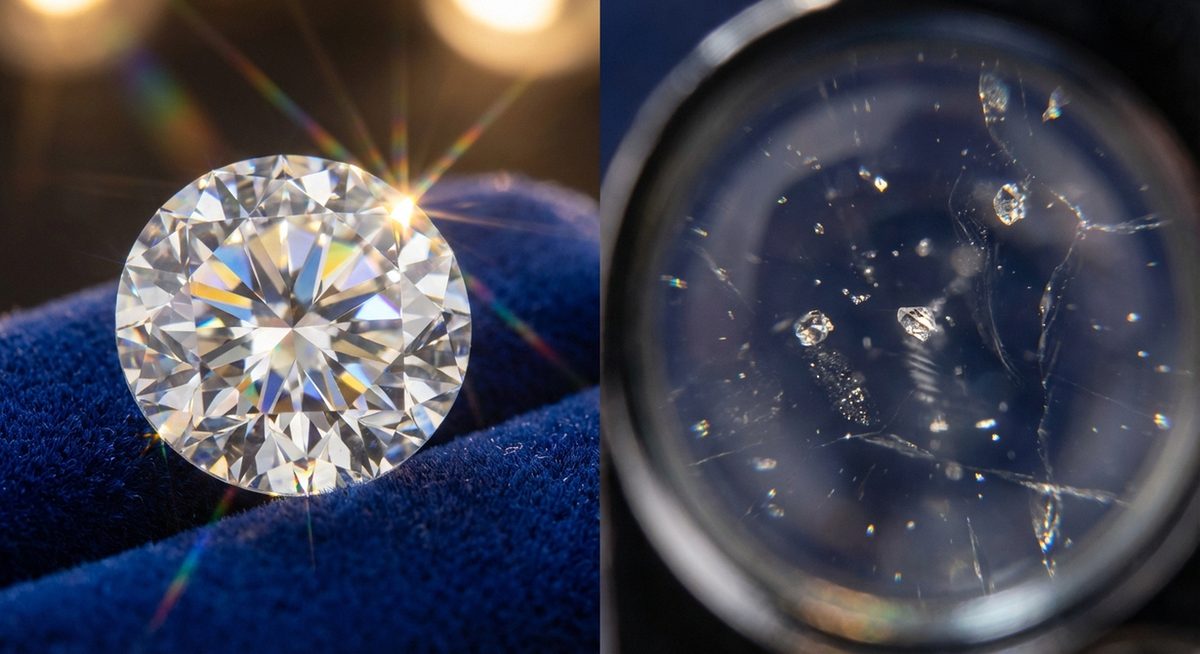
Diamond clarity refers to the evaluation of small imperfections that occur naturally on the surface and within a diamond. Internal characteristics are called inclusions, while surface irregularities are known as blemishes. Together, these are referred to as clarity characteristics. Because diamonds form deep within the Earth under extreme heat and pressure — typically at depths of 150 to 200 kilometres — nearly all natural diamonds contain some trace of their formation process.
Clarity is one of the four primary quality factors (the 4Cs) used to evaluate and price diamonds worldwide. The Gemological Institute of America (GIA) developed the standard clarity grading scale in the 1950s, and it remains the global benchmark used by gemologists, retailers, and consumers. For Canadian diamond buyers, understanding clarity is essential because it directly affects both the appearance and the price of a stone — and knowing where value lies can save thousands of dollars on a purchase.
The GIA Diamond Clarity Scale: All 11 Grades
The GIA clarity scale comprises 11 grades, divided into six categories. Every diamond is examined under 10× magnification by a trained gemologist who assesses the size, number, position, nature, and relief of any clarity characteristics. The grades range from Flawless — where no inclusions or blemishes are visible under magnification — down to Included, where flaws are obvious to the unaided eye.
- Flawless (FL) — No inclusions or blemishes visible under 10× magnification. Exceptionally rare; fewer than 1% of gem-quality diamonds achieve this grade.
- Internally Flawless (IF) — No inclusions visible under 10× magnification; only minor surface blemishes. These represent roughly 1–2% of the market.
- Very, Very Slightly Included 1 (VVS1) — Inclusions are so slight that they are extremely difficult for a skilled grader to detect under 10× magnification.
- Very, Very Slightly Included 2 (VVS2) — Inclusions are very difficult to see under 10× magnification, but marginally easier to locate than in VVS1.
- Very Slightly Included 1 (VS1) — Minor inclusions are difficult to see under 10× magnification. Not visible to the naked eye.
- Very Slightly Included 2 (VS2) — Minor inclusions are somewhat easy to see under 10× magnification but remain invisible to the unaided eye. This is the most popular grade in Canada for engagement rings.
- Slightly Included 1 (SI1) — Inclusions are noticeable under 10× magnification. In most shapes and sizes, SI1 diamonds are still eye-clean.
- Slightly Included 2 (SI2) — Inclusions are easily visible under magnification and may be visible to the naked eye, depending on their nature and location.
- Included 1 (I1) — Inclusions are obvious under 10× magnification and are typically visible to the naked eye. May slightly affect transparency or brilliance.
- Included 2 (I2) — Inclusions are easily visible to the naked eye and may affect the diamond's durability in addition to its appearance.
- Included 3 (I3) — Inclusions are very obvious, significantly affecting transparency, brilliance, and potentially structural integrity.
Interactive Clarity Explorer
Use the widget below to compare how inclusions look at each clarity grade. Select a grade to see a simulated 10× magnification view and learn what gemologists look for during grading.
Diamond Clarity Comparison Table
The following table summarises all 11 GIA clarity grades, their visibility, price impact, and ideal use cases. Use this as a quick reference when shopping for diamonds in Canada.
| Grade | Description | Visible to Naked Eye? | Price Impact | Best For |
|---|---|---|---|---|
| FL | Flawless — no inclusions or blemishes under 10× | No | Highest premium (60–70% above SI1) | Investment, collectors |
| IF | Internally Flawless — no internal inclusions under 10× | No | Very high premium | Investment, prestige purchases |
| VVS1 | Very very slight inclusions, extremely difficult to detect | No | High premium (30–40% above VS2) | Perfectionist buyers, high-end jewellery |
| VVS2 | Very very slight inclusions, very difficult to detect | No | Significant premium (20–30% above VS2) | Quality-focused buyers |
| VS1 | Very slight inclusions, difficult to see under 10× | No | Moderate premium (10–15% above VS2) | Engagement rings, fine jewellery |
| VS2 | Very slight inclusions, somewhat easy to see under 10× | No | Benchmark mid-range price | Best value for engagement rings |
| SI1 | Slight inclusions, noticeable under 10× | Rarely | 10–15% below VS2 | Budget-conscious buyers, larger carat weights |
| SI2 | Slight inclusions, easily seen under 10× | Sometimes | 20–25% below VS2 | Value buyers who inspect carefully |
| I1 | Included — visible inclusions that may affect brilliance | Yes | 40–50% below VS2 | Fashion jewellery, accent stones |
| I2 | Included — easily visible, may affect durability | Yes | 50–60% below VS2 | Generally not recommended |
| I3 | Included — very obvious, affects brilliance and structure | Yes | Lowest prices | Industrial use or very budget pieces |
How Diamond Clarity Is Graded
Professional clarity grading follows a rigorous process. A gemologist examines the diamond under 10× magnification — the industry standard established by the GIA. The grader evaluates five key factors that determine the final clarity grade:
- Size — Larger inclusions result in a lower clarity grade.
- Number — More inclusions generally lower the grade, though a single large inclusion can be worse than several tiny ones.
- Position — Inclusions near the centre of the table facet (the flat top surface) are more visible and impact the grade more severely than those near the girdle or pavilion.
- Nature — The type of inclusion matters. Some types, such as feathers that reach the surface, may raise durability concerns.
- Relief — How much the inclusion contrasts with the surrounding diamond. Dark inclusions in a colourless diamond stand out more than white or transparent ones.
Common Types of Diamond Inclusions
Gemologists identify several types of inclusions when grading clarity. Understanding these helps Canadian buyers read a diamond grading report with confidence:
- Crystals — Small mineral crystals trapped inside the diamond during formation. These can appear as light or dark spots.
- Feathers — Tiny fractures within the stone that resemble feathers. Small feathers rarely affect durability, but large ones that reach the surface can be a concern.
- Clouds — Clusters of pinpoint inclusions grouped tightly together. A light cloud has minimal impact, but a dense cloud can give the diamond a hazy or milky appearance.
- Pinpoints — Extremely small crystals that appear as tiny dots under magnification. These are the most common type of inclusion.
- Needles — Thin, elongated crystal inclusions that appear as fine lines. They are typically only visible under magnification and rarely impact appearance.
- Twinning Wisps — A series of pinpoints, clouds, or crystals that formed along the diamond's growth planes. These are especially common in fancy-shaped diamonds.
Canadian Diamond Clarity: What Sets Our Stones Apart
Canada's three major diamond mines — Ekati, Diavik, and Gahcho Kué — are all located in the Northwest Territories, near Lac de Gras. The geological conditions in this region, specifically the ancient kimberlite pipes that brought diamonds to the surface over a billion years ago, produce diamonds with distinctive clarity profiles.
While no mining operation produces exclusively high-clarity stones, Canadian mines are known for yielding a significant proportion of gem-quality diamonds in the VS to VVS range. Some industry analyses estimate that 30–40% of gem-quality production from the Ekati and Diavik mines grades VS2 or higher — a notable figure compared to global averages. The diamonds from these pipes tend to have fewer dark crystal inclusions and a higher proportion of transparent or white inclusions, which are less detrimental to appearance.
Canadian diamonds also carry the advantage of full traceability. Each stone mined in Canada can be tracked from the mine to the retailer, and many are laser-inscribed with a unique identification number on the girdle. This traceability, combined with Canada's strict environmental and labour regulations, makes Canadian diamonds a trusted choice. Explore our interactive mines map to learn more about where Canadian diamonds originate.
Eye-Clean Diamonds: The Practical Standard
The term "eye-clean" is not an official GIA grade but rather an industry term used to describe diamonds where inclusions are invisible to the unaided eye when viewed face-up at a standard distance of approximately 25 centimetres. For the vast majority of buyers, an eye-clean diamond is indistinguishable from a Flawless one in normal wear.
As a general rule, diamonds graded VS2 and above are virtually always eye-clean. Many SI1 diamonds are also eye-clean, particularly in round brilliant cuts where the faceting pattern helps mask inclusions. However, step-cut shapes like emerald and Asscher cuts have large, open facets that make inclusions more visible — for these shapes, a VS2 or higher is advisable.
Canadian buyers who prioritise appearance without overpaying should focus on the eye-clean threshold. You gain no visual benefit from a VVS1 over a VS2 in daily wear, yet the price difference can be 25–35% for the same carat weight, cut, and colour grade.
How Clarity Affects Diamond Prices in Canada
Clarity is the third most impactful factor on diamond pricing after carat weight and cut quality. The price curve is not linear — the biggest premiums occur at the top of the scale, and the biggest discounts at the bottom.
For a 1.00-carat, round brilliant, G-colour, Excellent-cut diamond in the Canadian market, approximate price differences by clarity grade look like this:
- FL/IF: CAD $9,500–$12,000
- VVS1/VVS2: CAD $7,500–$9,000
- VS1/VS2: CAD $5,800–$7,200
- SI1/SI2: CAD $4,200–$5,500
- I1: CAD $2,800–$3,800
These figures are approximate and vary based on market conditions, retailer, and specific stone characteristics. For a more precise estimate tailored to your specifications, try our diamond price calculator.
The key takeaway for Canadian buyers: the jump from SI1 to VS2 costs roughly 15–20% more, while the jump from VS2 to VVS2 costs another 20–30%. Since both VS2 and VVS2 look identical to the naked eye, the value proposition of VS2 is clear.
Tips for Choosing the Right Clarity Grade
Selecting the right clarity grade depends on your priorities, budget, and the type of jewellery you are buying. Here are practical guidelines for Canadian diamond shoppers:
- Set your budget first. Determine your total budget, then allocate across the 4Cs. Clarity should not consume the majority of your budget — invest in cut quality first, as it has the greatest impact on a diamond's visual appeal.
- Aim for eye-clean. Unless you are buying for investment purposes, there is no practical reason to purchase above VS2. The price premium for higher grades buys you nothing visible in daily wear.
- Consider the diamond shape. Round brilliants hide inclusions well due to their complex faceting. If you are choosing an emerald, Asscher, or baguette shape, opt for at least VS2 to ensure inclusions remain hidden.
- Inspect SI1 diamonds individually. An SI1 diamond can represent excellent value if the inclusions are positioned near the edge of the stone or are transparent in nature. Always view the actual diamond or a high-resolution image before purchasing an SI1.
- Avoid I2 and I3 for engagement rings. These grades have visible inclusions that detract from the diamond's beauty and may compromise structural integrity over decades of wear.
- Request a GIA or AGS report. Always buy a diamond with a grading report from a reputable laboratory. In Canada, the Canadian Diamond Code of Conduct ensures additional traceability for domestically mined stones.
- Ask about fluorescence. Some diamonds with medium to strong blue fluorescence can appear slightly hazy, which compounds the visual effect of inclusions. Check the fluorescence field on the grading report.
Pro Tip: The best value in the Canadian diamond market is a VS2 clarity, G or H colour, Excellent cut diamond. This combination delivers a visually stunning stone at 30–40% less than a comparable Flawless or D-colour diamond. Pair this with a Canadian-origin stone for full traceability and ethical sourcing confidence.
Frequently Asked Questions About Diamond Clarity
What is diamond clarity?
Diamond clarity is a quality grade that measures the presence of internal characteristics (inclusions) and surface blemishes in a diamond. The Gemological Institute of America (GIA) grades clarity on a scale from Flawless (FL) to Included (I3), using 10× magnification. Fewer and smaller inclusions result in a higher clarity grade and typically a higher price.
What is the best clarity grade for an engagement ring?
For most engagement rings, VS1 or VS2 offers the best balance of quality and value. These grades are eye-clean, meaning inclusions cannot be seen without magnification, yet they cost significantly less than Flawless or Internally Flawless diamonds. In the Canadian market, VS2 is the most popular clarity grade for engagement rings.
Can you see inclusions with the naked eye?
Inclusions are generally invisible to the naked eye in diamonds graded SI1 and above. In SI2 diamonds, some inclusions may be visible depending on their size, location, and type. Diamonds graded I1, I2, or I3 have inclusions that are typically visible without magnification.
What does "eye-clean" mean?
An eye-clean diamond is one where no inclusions or blemishes are visible to the unaided eye when viewed face-up at a normal viewing distance of about 25 centimetres. Diamonds graded VS2 and above are almost always eye-clean. Many SI1 diamonds are also eye-clean, depending on the nature and placement of their inclusions.
Is VS1 or VS2 better value?
VS2 generally offers better value than VS1. Both grades are eye-clean, but VS2 diamonds typically cost 10–15% less than comparable VS1 stones. Since the inclusions in both grades are invisible without magnification, the visual difference is negligible. For budget-conscious buyers in Canada, VS2 is often the sweet spot.
What clarity do most people buy in Canada?
According to Canadian jewellery industry data, the most commonly purchased clarity grades in Canada are VS2 and SI1, which together account for roughly 55–60% of diamond engagement ring sales. Canadian buyers tend to prioritise eye-clean diamonds while seeking value, making these mid-range grades the most popular choice.
Do inclusions affect diamond durability?
In most cases, inclusions do not affect a diamond's durability. Diamonds are the hardest natural material on Earth (10 on the Mohs scale). However, in rare cases, large feather inclusions that reach the surface of an I2 or I3 diamond could potentially weaken the stone, especially if struck at exactly the right angle. For diamonds graded SI1 and above, durability is not a concern.
What is the difference between VVS1 and VVS2?
Both VVS1 and VVS2 diamonds have very, very slight inclusions that are extremely difficult to detect under 10× magnification. The difference lies in the difficulty: VVS1 inclusions are harder to find and are typically located further from the centre of the stone. In practice, even a trained gemologist needs time to identify inclusions in either grade, and the visual difference between them is indistinguishable to the naked eye.
How does clarity affect price?
Clarity has a significant impact on diamond pricing. Moving from one clarity grade to the next can change the price by 10–25%, depending on the grade and carat weight. The biggest price jumps occur between I1 and SI2, and between VS2 and VVS2. For a 1-carat round brilliant diamond, the price difference between an I1 and a Flawless stone can exceed 60–70%. In the Canadian market, clarity premiums tend to follow international Rapaport pricing with regional adjustments.
Are Canadian diamonds clearer than other diamonds?
Canadian diamonds are not inherently clearer than diamonds from other sources. Clarity depends on the geological conditions during formation, which vary within any deposit. However, Canadian diamond mines like Ekati, Diavik, and Gahcho Kué in the Northwest Territories do produce a notable proportion of high-clarity stones. Some Canadian operations report that 30–40% of their gem-quality output grades VS2 or higher, though this varies by pipe and production period.
What clarity grade should I avoid?
For engagement rings and fine jewellery, most experts recommend avoiding I2 and I3 clarity grades. These diamonds have inclusions that are easily visible to the naked eye and can affect the stone's brilliance and, in some cases, its structural integrity. I1 diamonds can be acceptable for certain settings and larger carat weights where slight inclusions are less noticeable, but buyers should inspect them carefully. For the best value without visible flaws, stick to SI1 or above.
Continue Your Diamond Education
Clarity is just one of the 4Cs. Explore the other factors that determine a diamond's beauty and value:
- Diamond Colour Guide — Understanding the D-to-Z colour grading scale
- Diamond Cut Guide — How cut quality affects brilliance and fire
- Diamond Carat Guide — Weight, size, and price relationships
- Diamond Price Calculator — Estimate diamond prices based on all 4Cs
- Canadian Diamond Certificates — GIA, AGS, and Canadian certification explained