What Is Diamond Carat Weight?
Carat is the standard unit of weight used for diamonds and other gemstones. One carat equals exactly 200 milligrams (0.2 grams), and each carat is subdivided into 100 points. A diamond weighing 0.75 carats, for instance, is commonly described as a "75-point" stone.
The word "carat" traces its origins to the carob seed. Ancient gem merchants in the Middle East and Mediterranean used carob seeds as counterweights on balance scales because the seeds had remarkably uniform mass — each weighing roughly 200 mg. By 1907, the metric carat was officially adopted at the Fourth General Conference on Weights and Measures, standardizing the measurement worldwide.
Carat is often the first of the 4Cs that buyers consider, largely because it has the most obvious impact on price. However, carat weight alone tells you surprisingly little about a diamond's visual size, beauty, or overall value. Understanding the nuances of how carat interacts with cut, colour, and clarity is essential to making a smart purchase — especially in the Canadian market, where buyers increasingly prioritize quality over sheer size.
Carat Weight vs. Diamond Size: Why Weight Does Not Equal Visual Size
One of the most common misconceptions is that a higher carat weight automatically means a bigger-looking diamond. In reality, two diamonds of identical carat weight can appear meaningfully different in size depending on their cut proportions, shape, and depth.
A round brilliant diamond cut with ideal proportions concentrates most of its weight on the top surface area (the "face-up" view that people see when the stone is set in a ring). A diamond cut too deep, however, hides weight in the pavilion (the bottom half), making the stone face up smaller than its carat weight suggests. Conversely, a shallow-cut diamond may look wider but will leak light and appear lifeless.
This is precisely why cut quality matters so much. A well-cut 0.90-carat diamond with excellent proportions can face up as large as — or even larger than — a poorly cut 1.00-carat stone. Canadian jewellers and gemologists consistently recommend investing in cut quality before chasing carat weight, because a beautifully proportioned diamond always outshines a larger but poorly cut one.
Diamond shape also influences perceived size. Elongated shapes such as oval, marquise, and pear distribute weight over a larger surface area, creating the illusion of a bigger stone. A 1-carat oval diamond, for example, typically measures about 7.7 mm in length compared to 6.5 mm for a round — appearing roughly 10% larger to the eye.
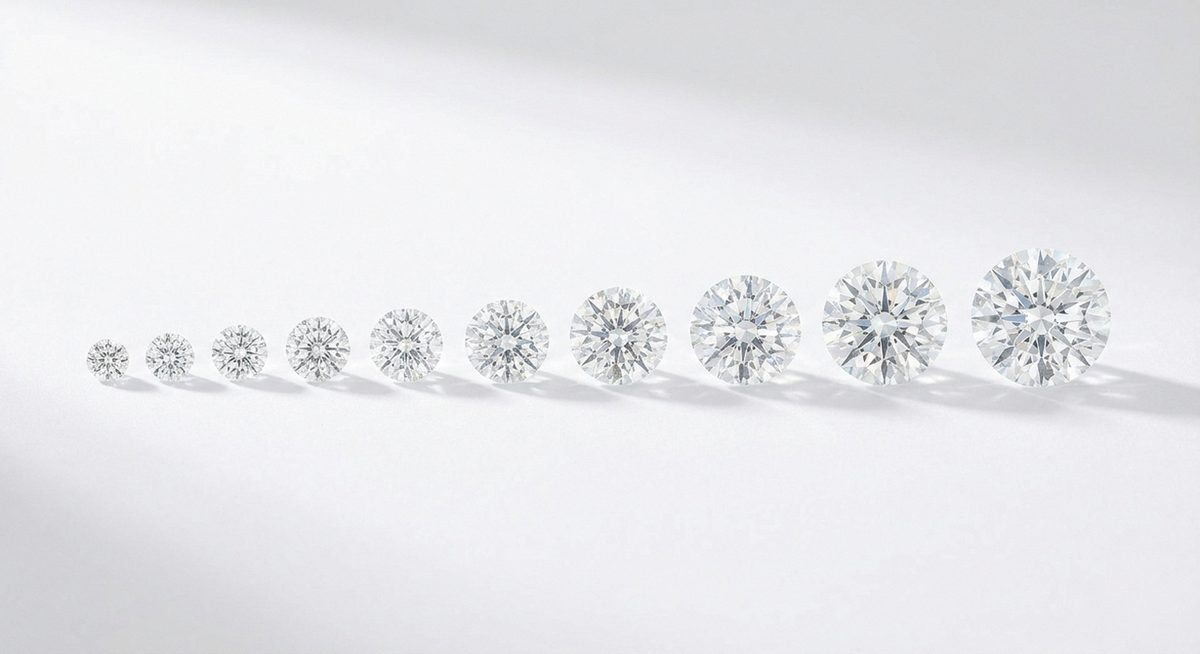
Compare Diamond Carat Sizes Visually
Use the interactive tool below to compare how different carat weights look relative to each other. Click any circle or drag the slider to explore sizes from 0.25 ct to 5.00 ct.
Diamond Carat Size, Diameter, and Price Comparison Table
The table below shows approximate diameters and Canadian price ranges for round brilliant diamonds at various carat weights. Prices reflect G colour and VS2 clarity with very good to excellent cut — a popular combination among Canadian buyers. Actual prices vary by retailer, certification lab, and market conditions.
| Carat | Diameter (mm) | Approx. Size | Price Range (CAD, G/VS2) | Price per Carat (CAD) |
|---|---|---|---|---|
| 0.25 ct | 4.1 mm | Small accent stone | $400 – $1,200 | $1,600 – $4,800 |
| 0.50 ct | 5.2 mm | Petite solitaire | $1,000 – $4,000 | $2,000 – $8,000 |
| 0.75 ct | 5.8 mm | Classic solitaire | $2,000 – $6,500 | $2,700 – $8,700 |
| 1.00 ct | 6.5 mm | Benchmark solitaire | $4,000 – $16,000 | $4,000 – $16,000 |
| 1.25 ct | 6.9 mm | Above-average centre | $5,500 – $20,000 | $4,400 – $16,000 |
| 1.50 ct | 7.4 mm | Statement solitaire | $7,000 – $28,000 | $4,700 – $18,700 |
| 2.00 ct | 8.2 mm | Luxury centre stone | $12,000 – $50,000 | $6,000 – $25,000 |
| 3.00 ct | 9.3 mm | Exceptional statement | $25,000 – $100,000+ | $8,300 – $33,300+ |
| 5.00 ct | 11.0 mm | Museum-quality rarity | $75,000 – $300,000+ | $15,000 – $60,000+ |
Prices are approximate and reflect the Canadian retail market as of early 2026. Data sources include our price calculator, Rapaport, and published dealer lists. Certified stones (GIA, AGS, or Canadian certificates) may carry a premium.
Magic Sizes and Why Diamond Prices Jump at Round Numbers
In the diamond industry, certain carat weights are known as "magic sizes" — the round-number thresholds of 0.50 ct, 1.00 ct, 1.50 ct, and 2.00 ct where prices increase disproportionately. The price jump has nothing to do with a sudden change in the diamond's physical properties. It is driven purely by consumer psychology.
Buyers overwhelmingly search for "1-carat diamond" rather than "0.95-carat diamond." Retailers and cutters know this, so rough diamonds are often cut to hit these magic thresholds — sometimes at the expense of ideal proportions. A cutter with a piece of rough that could yield a beautifully proportioned 0.92-carat stone may instead cut it to 1.01 carats with slightly inferior proportions, because the price per carat jumps so significantly at the 1.00 ct mark.
The price difference is dramatic. A 0.95-carat diamond with identical colour, clarity, and cut specifications may cost 15% to 20% less per carat than a 1.00-carat stone. Yet the visual difference — a mere 0.1 mm in diameter — is completely imperceptible once the stone is set.
Savvy Canadian diamond buyers exploit this by shopping just below magic sizes: 0.45–0.49 ct instead of 0.50, 0.90–0.99 ct instead of 1.00, and 1.40–1.49 ct instead of 1.50. The savings can amount to thousands of dollars, with virtually no visible difference.
How Carat Weight Affects Diamond Pricing: The Exponential Curve
Diamond pricing does not increase linearly with carat weight. A 2-carat diamond does not cost twice as much as a 1-carat diamond — it typically costs three to four times as much, assuming comparable quality across the other 4Cs. This exponential pricing curve is driven by rarity: large rough diamonds are exponentially rarer than small ones.
To illustrate, consider a round brilliant diamond with G colour, VS2 clarity, and excellent cut. At 1.00 ct, the price per carat in Canada might be around $8,000 CAD. At 2.00 ct, the price per carat climbs to roughly $16,000–$20,000 CAD — doubling the per-carat cost on top of doubling the weight. The total price therefore quadruples.
This exponential relationship becomes even more extreme beyond 3 carats. Only about one in every 1,000 mined rough diamonds is large enough to produce a finished stone over 1 carat, and the ratio drops to roughly one in 15,000 for 3-carat+ stones. From Canadian mines like Ekati and Diavik, the vast majority of production consists of stones under 1 carat, making larger Canadian-certified diamonds particularly scarce and valuable.
The practical takeaway: if budget is a constraint, reducing carat weight by even 10–15% can free up significant dollars to invest in a superior cut grade, which has the greatest impact on a diamond's visual beauty.
Canadian Diamond Production: What Carat Sizes Come from Our Mines?
Canada is the world's fourth-largest diamond producer by value, with production centred at the Ekati, Diavik, and Gahcho Kué mines in the Northwest Territories, plus the Victor mine in Ontario (now closed). According to Natural Resources Canada data, the country produced approximately 13.3 million carats in 2024, valued at $1.47 billion CAD.
The average rough diamond from Canadian mines weighs between 0.10 and 0.30 carats. After cutting and polishing — a process that typically removes 50–60% of the rough weight — most finished Canadian diamonds fall in the 0.03 to 0.15 carat range, destined for accent stones and pavé settings. Finished stones over 1 carat are comparatively rare in Canadian production, which is one reason why Canadian-certified diamonds of 1 carat or more carry a meaningful premium.
That said, Canadian mines have produced remarkable large stones. The Ekati mine yielded a 187.7-carat rough diamond in 2015, and the Diavik mine has recovered multiple stones exceeding 100 carats. These exceptional finds are cut and polished into high-value gems that command global attention.
When shopping for a Canadian diamond, look for the Government of the Northwest Territories (GNWT) certificate or a laser-inscribed polar bear hallmark, which verify Canadian origin. These provenance guarantees are especially meaningful for larger stones where the premium for Canadian origin is most significant.
Balancing Carat Weight with Cut, Colour, and Clarity
Carat weight is just one component of a diamond's overall beauty and value. The key to a smart purchase is finding the right balance among all four Cs. Here is how carat interacts with each:
Carat and Cut: Cut is the most important factor in a diamond's visual appeal. A smaller diamond with an excellent cut will always look more brilliant than a larger diamond with a fair or poor cut. If you must compromise, reduce carat before reducing cut quality. The jump from "Very Good" to "Excellent" cut is often worth more to the eye than an additional 0.10 carats.
Carat and Colour: Larger diamonds show colour more readily. A faint yellow tint that is invisible in a 0.50-carat stone may become noticeable in a 2-carat diamond. If you are buying a diamond above 1.50 carats, consider moving one colour grade higher (e.g., G instead of H) to maintain a colourless appearance. For stones under 1 carat, H or even I colour is typically eye-clean.
Carat and Clarity: Similarly, inclusions are more visible in larger diamonds because the bigger facets create wider windows into the stone. A VS2 clarity grade that is perfectly eye-clean at 0.75 carats might show a visible inclusion at 2 carats. For diamonds over 1.50 carats, consider stepping up to VS1 or VVS2 to ensure the stone remains eye-clean.
Total Carat Weight (TCW) in Multi-Stone Rings
When shopping for engagement rings and other diamond jewellery, you will frequently encounter the term total carat weight (TCW), sometimes written as "ctw." This refers to the combined weight of all diamonds in the piece — not the weight of the centre stone alone.
A ring described as "2.00 ctw" might feature a 1.20-carat centre stone flanked by side stones and a pavé band totalling the remaining 0.80 carats. The distinction matters enormously for value: a single 2-carat diamond is worth far more than twenty 0.10-carat stones adding up to the same total weight, because large individual stones are exponentially rarer.
Always ask the jeweller to disclose the centre-stone carat weight separately from the total carat weight. Reputable Canadian jewellers will provide this information clearly on the receipt and the accompanying certificate. If a seller only quotes TCW without breaking down individual stone weights, that is a red flag.
Tips for Maximizing Carat Weight on a Budget
Getting the most visual impact for your dollar requires strategic thinking. Here are proven approaches that Canadian diamond buyers use to maximize perceived size without overpaying:
- Buy just below magic sizes. As discussed above, a 0.90 ct or 0.95 ct diamond looks virtually identical to a 1.00 ct stone but costs 15–20% less. The same logic applies at 0.48 ct, 1.45 ct, and 1.95 ct.
- Choose elongated shapes. Oval, marquise, and pear-shaped diamonds spread their weight over a longer surface area, appearing up to 15% larger than a round of the same carat weight. An oval is an especially popular choice in Canada for this reason.
- Consider a halo setting. A halo of small diamonds surrounding the centre stone can make a 0.75-carat diamond appear as large as a 1-carat solitaire. The cost of the halo stones is a fraction of upgrading the centre stone.
- Opt for a slim band. A thinner band creates more contrast and makes the centre stone appear larger. A 1.5 mm to 2.0 mm band width is ideal for maximizing the visual presence of the diamond.
- Prioritize excellent cut. A well-cut diamond maximizes face-up surface area and light return. This means the stone looks larger and more brilliant — a double benefit. Use our price calculator to compare options.
- Compare face-up measurements, not just carats. Two diamonds both weighing 1.00 ct can differ by 0.3 mm or more in diameter depending on cut depth. Always check the millimetre measurements in the certificate.
Pro Tip: The 0.90-Carat Strategy
If your heart is set on a 1-carat diamond, consider a 0.90 ct stone with an excellent cut instead. At 6.2 mm diameter versus 6.5 mm, the difference is invisible once set in a ring — but you could save $1,500 to $3,000 CAD. Put that savings toward a superior setting, a better colour grade, or simply keep it in your pocket. This is the single most effective money-saving strategy in the diamond market.
Frequently Asked Questions About Diamond Carat Weight
A diamond carat is a unit of weight equal to 200 milligrams (0.2 grams). The term originates from carob seeds, which ancient gem traders used as counterweights on balance scales because of their remarkably uniform weight. One carat is subdivided into 100 points, so a 0.75-carat diamond may be referred to as a "75-point" stone.
A well-cut 1-carat round brilliant diamond measures approximately 6.4 to 6.5 mm in diameter — roughly the width of a standard pencil eraser. However, the visual size depends heavily on the quality of the cut. A poorly proportioned 1-carat diamond can appear noticeably smaller or larger than its weight suggests.
The most popular carat size for engagement rings in Canada is between 0.50 and 1.00 carat, with the average hovering around 0.70 to 0.90 carats. Canadian buyers tend to favour quality over sheer size, often choosing a slightly smaller diamond with superior cut, colour, and clarity rather than maximizing carat weight alone.
Diamond prices jump at "magic sizes" — 0.50 ct, 1.00 ct, 1.50 ct, and 2.00 ct — because of high consumer demand at these round numbers. Buyers psychologically anchor to these milestones, creating disproportionate demand. A 1.00-carat diamond may cost 15–20% more per carat than a 0.95-carat stone that looks virtually identical face-up.
No. A 0.90-carat round brilliant measures about 6.2 mm across, compared to 6.5 mm for a 1.00-carat stone — a difference of just 0.3 mm that is virtually undetectable to the naked eye once set in a ring. Yet the price difference can be 15–20%, making a 0.90-carat diamond one of the smartest purchases in the market.
Carat weight itself does not determine sparkle — that is primarily governed by the quality of the cut. A smaller diamond with an excellent cut will display more brilliance and fire than a larger diamond with a poor cut. However, larger diamonds do have bigger facets, which can produce bolder flashes of light and more noticeable fire patterns.
Total carat weight (TCW) refers to the combined weight of all diamonds in a piece of jewellery. For example, a three-stone ring might be advertised as "2.00 ctw" — meaning the three stones together weigh 2 carats, not that each stone is 2 carats. Always ask for the individual carat weight of the centre stone separately.
A 2-carat round brilliant diamond in Canada typically ranges from $12,000 to $50,000 CAD or more, depending on cut, colour, and clarity. A well-balanced choice such as a 2-carat stone with G colour, VS2 clarity, and excellent cut would fall in the $18,000–$28,000 CAD range from reputable Canadian jewellers.
The ideal carat size depends on finger size and hand proportions. On slender fingers (size 4–5), a 0.75 to 1.00 carat diamond appears proportional and elegant. On average fingers (size 6–7), 1.00 to 1.50 carats tends to look balanced. On larger fingers (size 8+), stones of 1.50 carats or more tend to look most proportionate. Elongated shapes like oval or marquise face up larger than rounds of the same weight.
Yes, significantly. Large rough diamonds are exponentially rarer than small ones. Only about 1 in 1,000 mined rough diamonds is large enough to yield a finished stone over 1 carat. This rarity compounds with quality — a large diamond with top colour and clarity is exceedingly rare, which is why prices increase exponentially rather than linearly with carat weight.
Cut quality should almost always be prioritized over carat weight. A beautifully cut diamond maximizes the light that enters and returns to the eye, creating the brilliance and fire that make a diamond desirable. A 0.90-carat stone with an excellent cut will look more impressive than a poorly cut 1.10-carat diamond — and likely cost less. Most gemologists and Canadian jewellers recommend never dropping below "Very Good" cut grade.
Continue Your Diamond Education
Clarity Guide
Learn how inclusions and blemishes are graded, and which clarity grades offer the best value for eye-clean diamonds.
Colour Guide
Understand the D-to-Z colour scale, see how colour varies across grades, and discover why H is Canada's most popular choice.
Cut Guide
Explore how cut proportions determine brilliance and fire, and why cut is the most important of the 4Cs.
Prices in Canada
Current diamond pricing data for the Canadian market, with breakdowns by carat, colour, clarity, and shape.
Price Calculator
Estimate what you should expect to pay for a diamond in Canada based on the 4Cs and current market data.
Engagement Rings
Browse ring settings and styles, and learn how the right setting can maximize the visual impact of your diamond.