Introduction: Why You Need This Guide
Buying a diamond is one of the most significant purchases most Canadians will ever make — and one of the most confusing. The diamond industry uses specialised grading systems, opaque pricing structures, and technical vocabulary that can leave even well-researched buyers feeling uncertain. Add in the emotional pressure of choosing an engagement ring and the financial stakes of spending several thousand dollars, and it is no wonder that many buyers either overpay for features they cannot see or compromise on qualities that genuinely matter.
This guide exists to change that. Written specifically for Canadian buyers, it walks you through every step of the diamond purchasing process — from setting a realistic budget in Canadian dollars to getting your ring insured after purchase. Whether you are buying your first engagement ring in Toronto, upgrading an anniversary band in Vancouver, or selecting a loose stone from a wholesaler in Yellowknife, this guide gives you the knowledge to buy with confidence.
You will learn how to prioritise the 4Cs for maximum visual impact per dollar, how to verify that a "Canadian diamond" is genuinely Canadian, how much you should actually expect to pay (including provincial taxes), and what red flags to watch for. At the end, you will find a comprehensive buyer's checklist that you can print out and take with you to the jeweller.
1 Set Your Budget
Before you look at a single stone, establish a firm budget. This is the single most important decision you will make because it shapes every choice that follows.
Debunking the "Two Months' Salary" Myth
The idea that you should spend two to three months' salary on an engagement ring is a marketing invention. De Beers coined the "two months' salary" rule in a 1930s advertising campaign designed to increase diamond sales during the Great Depression. It has no basis in financial planning, cultural tradition, or common sense. Spend what you can comfortably afford without taking on high-interest debt.
What Canadians Actually Spend
According to industry data, the average Canadian spends between $5,000 and $8,000 CAD on an engagement ring (diamond plus setting). That figure varies widely by region: buyers in Toronto and Vancouver tend to spend more than the national average, while buyers in the Prairie provinces and Atlantic Canada typically spend less. A beautiful, high-quality diamond engagement ring is absolutely achievable in the $3,000 to $6,000 range if you prioritise wisely across the 4Cs.
Budget Allocation Strategy
A sensible rule of thumb is to allocate your total ring budget roughly as follows:
- 70–80% for the diamond itself
- 15–25% for the setting (metal and craftsmanship)
- 5–10% for taxes, insurance, and a professional appraisal
Tax Considerations Across Canada
Do not forget to factor in sales tax, which varies significantly by province. In Alberta, you pay only 5% GST. In Ontario, you pay 13% HST. In British Columbia, the combined GST and PST total 12%. On a $6,000 diamond, that is the difference between $300 and $780 in tax — a meaningful amount. Some buyers in border provinces drive to Alberta specifically to save on the tax, though you should be aware of interprovincial tax rules if you do this.
Financing Options
Many Canadian jewellers offer financing plans, often with promotional 0% interest periods of 6 to 12 months. If you choose financing, ensure the interest rate after the promotional period is reasonable and that you can realistically pay off the balance within the interest-free window. Avoid store credit cards with interest rates above 20%. If you need financing beyond 12 months, a personal line of credit from your bank will almost always offer a better rate than retailer financing.
2 Learn the 4Cs
The 4Cs — Cut, Colour, Clarity, and Carat Weight — are the universal language for describing and pricing diamonds. Understanding them is non-negotiable before making a purchase. Here is a brief overview with links to our detailed guides on each topic.
Cut: The Most Important C
Cut determines how well a diamond interacts with light. A superbly cut diamond sparkles brilliantly, masks minor colour tints, and makes inclusions less visible. It is the single most important factor in a diamond's beauty. Always prioritise an Excellent or Ideal cut grade — it is worth sacrificing half a carat or one colour grade to get the best cut.
Colour: Second Priority
Colour grades range from D (colourless) to Z (light yellow or brown). For the best value, look at G or H colour stones. They face up white in any setting and cost 15–25% less than D or E colour diamonds. If you are setting the diamond in yellow gold, you can go as low as J or K colour because the warm metal masks any faint tint.
Clarity: Third Priority
Clarity measures internal inclusions and surface blemishes. For most buyers, VS2 or SI1 is the sweet spot — these grades are eye-clean (no visible flaws without magnification) but cost significantly less than VVS or Flawless grades. Since you cannot see the difference with the naked eye, paying more buys you nothing visible.
Carat Weight: Last Priority
Carat weight is the size factor and the one most people focus on first — but it should actually be your last priority. A well-cut 0.90-carat diamond looks virtually identical in size to a 1.00-carat stone but can cost 15–20% less because of the psychological pricing premium at whole-carat marks. Consider "shy" carat weights (0.90, 1.40, 1.90) for better value.
Value Priority Order: Cut > Colour > Clarity > Carat. Follow this hierarchy and you will get the most beautiful diamond your budget allows.
3 Choose Your Diamond Shape
Diamond shape is a matter of personal preference, but each shape has practical implications for price, brilliance, and how large the diamond appears. There are ten standard diamond shapes available in the Canadian market.
In the Canadian market, round brilliants dominate, but ovals have seen a remarkable surge — growing from approximately 6% of engagement ring sales in 2018 to roughly 14% in 2025. If budget is a concern, fancy shapes (anything other than round) typically cost 20–40% less per carat than round brilliants of equivalent quality.
4 Choose Natural or Lab-Grown
One of the biggest decisions facing Canadian diamond buyers today is whether to purchase a natural mined diamond or a lab-grown diamond. Both are chemically, physically, and optically identical — they are both real diamonds. The difference lies in their origin, price, and long-term value.
Natural Diamonds
- Formed over 1–3 billion years deep within the Earth
- Finite supply; prices historically stable or appreciating
- Canadian natural diamonds are fully traceable from mine to retailer
- Retain 30–50% of retail value on resale
- Support Indigenous communities and northern economies in Canada
- Carry sentimental weight for buyers who value geological rarity
Lab-Grown Diamonds
- Created in weeks using HPHT or CVD technology
- 60–80% less expensive than natural diamonds of identical quality
- Unlimited supply; prices have been declining year over year
- Minimal resale value (5–15% of purchase price)
- Lower environmental impact per carat (though energy-intensive to produce)
- Ideal for buyers who prioritise size and appearance over rarity
There is no objectively "better" choice. If you want a larger, more impressive-looking diamond and do not plan to resell, lab-grown offers outstanding value. If you value rarity, tradition, long-term value retention, and supporting Canada's northern mining communities, natural is the way to go. Many Canadian couples today purchase a lab-grown diamond for the engagement ring and invest the savings elsewhere.
5 Demand Proper Certification
Never buy a diamond without an independent grading report. This is non-negotiable, regardless of whether you are spending $1,500 or $15,000. A certificate from a reputable laboratory is your proof that the diamond is what the seller claims it is.
Trusted Laboratories
- GIA (Gemological Institute of America) — The gold standard worldwide. GIA grading is the most consistent and widely recognised. Always your best option.
- AGS (American Gem Society) — Highly respected, particularly for cut grading. Their "AGS Ideal" cut grade is rigorous.
- GSI, IGI, EGL — These labs are generally considered less strict than GIA or AGS. A diamond graded G colour / VS2 clarity by EGL might grade as H / SI1 by GIA. Be cautious with non-GIA/AGS reports.
Canadian Diamond Certification
If you are buying a diamond marketed as "Canadian," demand proof. Genuine Canadian diamonds carry one or more of these credentials:
- CanadaMark — The premier Canadian diamond hallmark, administered by Dominion Diamond Mines (now owned by Washington Diamond). Guarantees the stone was mined in the Northwest Territories.
- GNWT Certificate — The Government of the Northwest Territories issues certificates for diamonds mined and cut within the territory.
- Laser Inscription — Canadian diamonds are typically laser-inscribed on the girdle with a unique ID number that links to the stone's provenance records.
For a comprehensive explanation of certification types and what to look for, see our Canadian diamond certificate guide.
6 Compare Prices Thoroughly
Diamond pricing is not standardised the way consumer electronics or automobiles are. Two diamonds with identical 4Cs on their certificates can differ in price by 20% or more depending on the retailer, specific stone characteristics not captured in the grade, and market conditions. That makes comparison shopping essential.
How to Research Prices
- Use our diamond price calculator to get a baseline estimate for your desired 4Cs combination in Canadian dollars.
- Check current Canadian diamond prices for market trends and average pricing data.
- Get quotes from at least three sources — one online retailer, one independent local jeweller, and one chain store. This gives you a realistic price range.
- Consider wholesale options if you are buying a loose stone. Wholesale buyers in Canada can save 15–25% below retail, particularly in diamond districts in Toronto and Vancouver.
Online vs. Brick-and-Mortar
Online diamond retailers in Canada typically offer prices 20–40% below physical stores because of lower overhead. Reputable platforms ship with full GIA certification and offer 30-day return policies. However, buying in person allows you to see the diamond's actual appearance under different lighting conditions and have it set immediately. Many savvy buyers use a hybrid approach: research and benchmark prices online, then visit local jewellers armed with that knowledge.
Red Flags in Diamond Pricing
- A price dramatically below market average (more than 35% below) — may indicate inflated grading or a treated/enhanced diamond
- No independent grading report or only an in-house appraisal
- "Sale" prices that are always on sale — the markdown is fictitious
- Pressure to buy immediately ("this stone won't last")
- Reluctance to let you take the diamond for an independent appraisal
7 Inspect the Diamond in Person
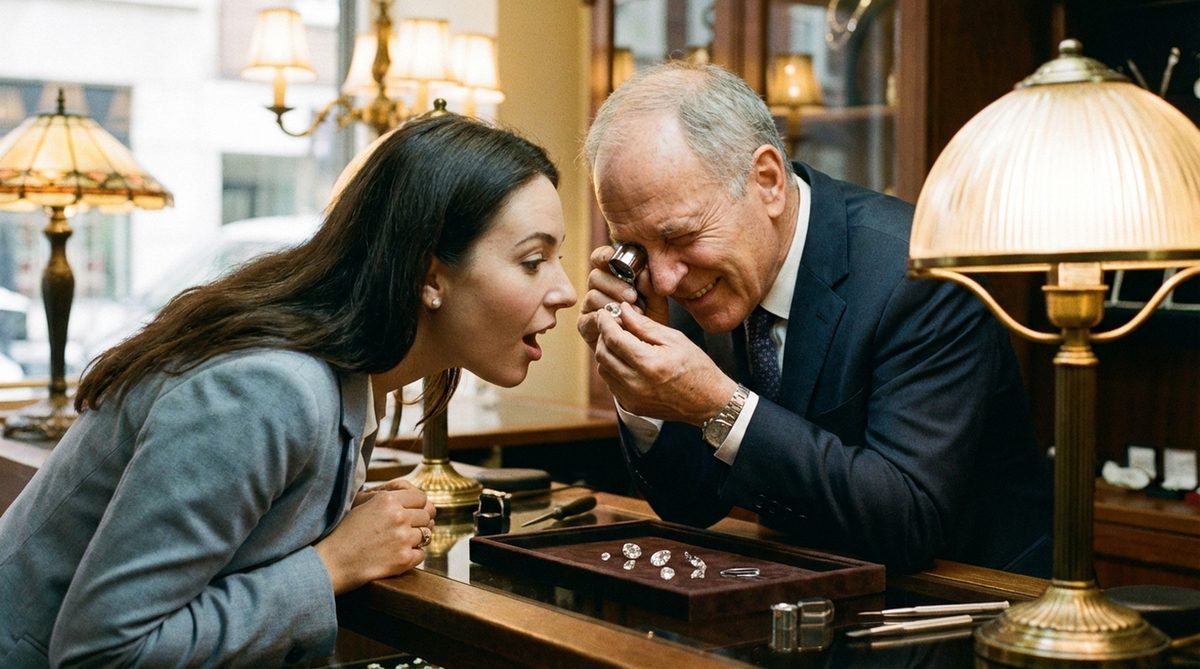
Whenever possible, inspect the diamond before committing to the purchase. Even if you are buying online, reputable retailers offer inspection periods. Here is what to look for and how to evaluate a diamond like a professional.
What You Need
- A jeweller's loupe (10x magnification) — You can purchase one for $15–30 CAD. Hold the loupe close to your eye and bring the diamond up to it, not the other way round.
- Good lighting — Daylight-equivalent lighting is ideal. Avoid harsh spotlights, which can make any diamond look brilliant, and avoid fluorescent lighting, which can affect colour perception.
- The grading report — Have the GIA or AGS report in hand so you can cross-reference the plotted inclusions with what you see.
What to Examine
- Brilliance and fire — Tilt the diamond slowly under the light. A well-cut stone will produce bright white light (brilliance) and rainbow flashes (fire) consistently across the surface.
- Eye-cleanliness — Hold the diamond at arm's length (roughly 25 centimetres) and look for any visible spots, clouds, or dark areas. If you can see inclusions at this distance, the diamond is not eye-clean.
- Symmetry — Look at the diamond face-up. The facet pattern should appear even and symmetrical. Any obvious asymmetry suggests a cut quality issue.
- Colour — Place the diamond face-down on a white surface next to a master colour reference if available. Compare the body colour to the grade stated on the certificate.
- Girdle thickness — Check that the girdle (the narrow band around the diamond's widest point) is neither extremely thin (fragile) nor extremely thick (adds weight without size).
- Fluorescence — If the report indicates medium or strong fluorescence, view the diamond under UV light. Some fluorescent diamonds appear hazy in sunlight.
8 Choose Your Setting
The setting is the metal framework that holds the diamond. It affects the ring's appearance, durability, and price. For Canadian buyers, the most popular choices are:
Metal Options
| Metal | Purity | Price Range (CAD) | Pros | Cons |
|---|---|---|---|---|
| 14K White Gold | 58.3% gold | $400–$800 | Most popular in Canada. Affordable. Durable for daily wear. | Requires rhodium plating every 1–2 years to maintain white colour. |
| 18K White Gold | 75% gold | $600–$1,200 | Richer colour. Slightly softer (better for intricate designs). | More expensive. Needs rhodium plating more frequently. |
| Platinum | 95% platinum | $1,000–$2,500 | Naturally white. Hypoallergenic. Extremely durable. No plating needed. | Most expensive. Heavier. Develops a patina over time. |
| 14K Yellow Gold | 58.3% gold | $400–$800 | Classic, warm appearance. Complements warmer skin tones. Hides lower colour grades. | Can make higher colour grades appear slightly warm. |
| 14K Rose Gold | 58.3% gold + copper | $400–$800 | Romantic, unique appearance. Growing in popularity. Very durable due to copper content. | Not suitable for those with copper allergies. |
| Palladium | 95% palladium | $700–$1,500 | Naturally white. Lighter than platinum. Hypoallergenic. No plating needed. | Less widely available in Canada. Harder to resize. |
Popular Setting Styles
- Solitaire — A single diamond in a simple prong setting. Timeless, lets the diamond take centre stage. The most popular style in Canada.
- Halo — A ring of smaller diamonds surrounds the centre stone, making it appear 10–15% larger. Offers excellent perceived value.
- Pavé — Tiny diamonds set along the band. Adds sparkle and visual interest without significantly increasing cost.
- Three-stone — A centre diamond flanked by two smaller stones. Symbolises past, present, and future.
- Bezel — The diamond is encased in a metal rim. Extremely secure. Ideal for active lifestyles and outdoor-loving Canadians.
- Tension — The diamond appears to float between the two sides of the band. Modern and distinctive.
For more guidance on engagement ring styles popular in Canada, explore our dedicated rings guide.
9 Negotiate and Purchase
The sticker price on a diamond at a Canadian jewellery store is rarely the final price. With the right approach, you can save 10–20% through negotiation — or secure valuable extras at no additional cost.
Negotiation Tips for Canadian Buyers
- Do your homework first. Know the market price for the specific 4Cs you want. Print out comparable listings from online retailers and use our pricing data as a reference. Walking in prepared immediately signals that you are an informed buyer.
- Ask for a cash discount. Many independent jewellers in Canada offer 5–10% off for cash or debit payment because it saves them credit card processing fees.
- Bundle the diamond and setting. You have more negotiating leverage when purchasing both together. Ask for a package discount.
- Request value-added extras. If the jeweller will not budge on price, ask for free ring resizing, professional cleaning for life, a complimentary appraisal, or a free watch battery replacement — these cost the jeweller very little but add genuine value for you.
- Be willing to walk away. This is your most powerful tool. If the price is not right, politely thank the jeweller and leave. In many cases, they will call you within a day or two with a better offer.
- Visit during off-peak times. January and mid-summer are the slowest periods for Canadian jewellers. You will receive more attention and find more flexibility on pricing.
Return Policies
Before finalising your purchase, confirm the return and exchange policy in writing. Most reputable Canadian jewellers offer a 30-day return period. Some chain retailers offer 60 or 90 days. Key points to confirm:
- Is it a full refund or store credit?
- Are there restocking fees? (Some retailers charge 10–15%)
- Does the return window start from the date of purchase or the date of delivery?
- Can you exchange for a different diamond within the return window?
10 Get Insurance and Care for Your Diamond
Your diamond purchase does not end at the register. Proper insurance and care will protect your investment for decades.
Insurance Options in Canada
Diamond rings should be insured against loss, theft, accidental damage, and mysterious disappearance. You have two main options:
- Home insurance rider — Most Canadian home or tenant insurance policies allow you to add a scheduled jewellery rider. The typical cost is 1–2% of the appraised value per year. For a ring appraised at $7,000 CAD, that is $70–$140 annually. Coverage varies — confirm whether your policy covers loss outside the home, accidental damage, and replacement at current market value.
- Specialist jewellery insurance — Companies like Jewellers Mutual and BFL Canada offer comprehensive standalone policies specifically for fine jewellery. These typically cover a wider range of scenarios, offer agreed-value replacement, and do not affect your home insurance deductible or claims history.
Getting an Appraisal
For insurance purposes, you need a written appraisal from an independent, certified appraiser — not the jeweller who sold you the ring. In Canada, look for appraisers certified by the Canadian Jewellers Association (CJA) or holding a Graduate Gemologist (GG) designation from the GIA. The appraisal should be completed within 30 days of purchase. Update it every two to three years, as diamond values fluctuate.
Daily Care and Maintenance
- Cleaning: Soak the ring in warm water with a few drops of mild dish soap for 20 minutes. Gently scrub with a soft toothbrush, particularly around the setting where grime accumulates. Rinse thoroughly and pat dry.
- Professional cleaning: Have your ring professionally cleaned and inspected every six months. Most Canadian jewellers offer this service free of charge.
- Storage: Store your diamond ring separately from other jewellery to prevent scratching. Diamonds can scratch other gemstones and metals.
- Remove during activities: Take off your ring when doing heavy manual work, exercising, swimming in chlorinated pools, or applying hand lotion or sunscreen.
- Prong checks: Have the prongs inspected annually. A loose prong is the most common cause of diamond loss from a ring setting. This is especially important in Canada's cold climate, as metal contracts in winter temperatures and prongs can work loose over time.