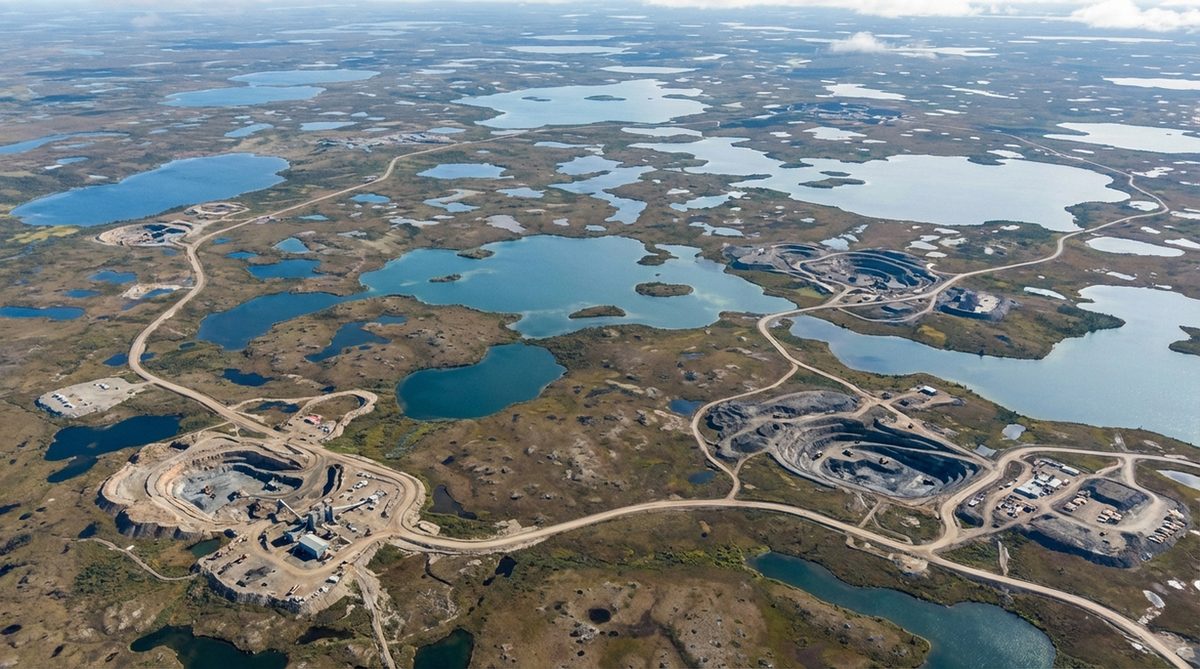
Canada's diamond geography is defined by ancient geological forces that shaped the Canadian Shield billions of years ago. Deep beneath the boreal forests and Arctic tundra of the Northwest Territories, kimberlite pipes — the volcanic conduits that carry diamonds from the Earth's mantle to the surface — cluster in remarkable density around the Lac de Gras region. This remote area, roughly 300 kilometres northeast of Yellowknife, hosts all three of Canada's currently operating diamond mines and hundreds of known kimberlite occurrences. Beyond the NWT, diamondiferous kimberlites have been discovered in Ontario, Quebec, Saskatchewan, Alberta, and Nunavut, making Canada one of the most geologically significant diamond provinces on the planet. The interactive map below plots every major mine, closed operation, advanced exploration project, and the known distribution of kimberlite pipes across the country, providing a comprehensive spatial overview of Canada's diamond endowment.
Understanding the geographic distribution of diamond mines and kimberlite occurrences is essential for anyone studying the Canadian diamond industry — whether you are an investor evaluating exploration-stage companies, a geologist researching craton architecture, a policy analyst assessing resource revenue, or simply a diamond enthusiast curious about where your Canadian stone originated. The Slave Craton, which underlies much of the central NWT, is the geological engine behind Canada's diamond wealth. Its deep lithospheric roots — extending more than 200 kilometres into the mantle — provide the stable, cool conditions necessary for diamond formation over billions of years. When kimberlite magma erupted through these ancient roots between 45 and 75 million years ago, it sampled diamonds that had formed at pressures exceeding 50 kilobars and temperatures above 1,000 degrees Celsius, delivering them to within a few hundred metres of the surface where modern mining can reach them.
Interactive Map of Canadian Diamond Mines
Use the map below to explore mine locations, kimberlite fields, and exploration projects. Click any marker for details including operator, production status, and estimated reserves. Zoom in to the Lac de Gras cluster to see the spatial relationship between the Ekati, Diavik, and Gahcho Kué operations.
Diamond Mine Regions Across Canada
Northwest Territories — Lac de Gras District
The Lac de Gras area is the epicentre of Canadian diamond mining. Situated on the Slave Craton approximately 300 km northeast of Yellowknife, this region hosts all three of Canada's producing mines. The area was virtually unknown to the mining world until 1991, when geologists Chuck Fipke and Stewart Blusson traced a trail of indicator minerals — pyrope garnets, chrome diopsides, and ilmenites — to their kimberlite source at Point Lake. Their discovery triggered the largest mineral staking rush in North American history, with over 300,000 claims staked within two years.
The Ekati Diamond Mine, opened in 1998 by BHP Billiton (now owned by Arctic Canadian Diamond Company), was Canada's first commercial diamond operation. It processes kimberlite from multiple open-pit and underground pipes across its mining lease. The Diavik Diamond Mine, operated by Rio Tinto since 2003, sits on a 20-square-kilometre island in Lac de Gras and has produced over 100 million carats during its operational life. The Gahcho Kué Diamond Mine, the newest of the three, commenced production in 2016 as a joint venture between De Beers (51%) and Mountain Province Diamonds (49%). Gahcho Kué processes three kimberlite pipes — 5034, Hearne, and Tuzo — and represents one of the richest new diamond discoveries globally in terms of grade and value per tonne.
The Lac de Gras region also contains the Snap Lake Mine, which De Beers operated from 2008 to 2015 before placing it on care and maintenance due to challenging geological conditions and water management issues. Snap Lake was notable as Canada's first entirely underground diamond mine, processing a thin kimberlite dyke rather than a traditional pipe. Additionally, the nearby Kennady North project (Mountain Province Diamonds) contains several diamondiferous kimberlite bodies that could extend the region's mining life well into the 2040s.
Ontario — Victor Mine (Attawapiskat, 2008–2019)
The Victor Diamond Mine, located in the James Bay Lowlands near Attawapiskat First Nation in northern Ontario, was the province's first and only diamond mine. Operated by De Beers Canada, Victor opened in 2008 after more than a decade of exploration and environmental assessment. The mine processed kimberlite from a single open pit and produced between 600,000 and 800,000 carats annually during peak years. Over its 11-year lifespan, Victor yielded more than 8 million carats of rough diamonds, including several notable large stones. The operation closed permanently in 2019 after exhausting its economically recoverable ore reserves. De Beers is currently managing the site's environmental rehabilitation in collaboration with Attawapiskat First Nation.
The Victor kimberlite pipe is part of the larger Attawapiskat kimberlite field, which contains over 20 kimberlite bodies. While Victor was the only pipe developed for mining, several others — including Tango, Delta, and Zulu — showed diamondiferous potential during exploration. The region's geology, underlain by the Superior Craton, demonstrates that Ontario's diamond potential extends well beyond a single mine, though the remote location and challenging muskeg terrain present significant logistical hurdles for future development.
Saskatchewan — Fort à la Corne Kimberlite Field
Saskatchewan's Fort à la Corne kimberlite field, located approximately 60 km east of Prince Albert, is one of the most geologically remarkable diamond occurrences in the world. The field contains more than 70 kimberlite bodies, including the Star-Orion South deposit — one of the largest diamondiferous kimberlite deposits ever discovered by surface area. Unlike the NWT kimberlites, which are relatively small but high-grade pipes, the Fort à la Corne bodies are massive, low-grade volcanic structures that erupted through younger sedimentary cover rather than directly through the craton surface.
Star Diamond Corporation (formerly Shore Gold) has been advancing the Star-Orion South project through decades of exploration and feasibility work. The deposit's enormous size — the kimberlite body extends over 200 hectares — means it contains a very large total diamond endowment, but the lower grade (approximately 14 carats per hundred tonnes) makes economic extraction more challenging than at higher-grade NWT operations. Rio Tinto previously held a joint venture interest in the project. If developed, an open-pit mine at Fort à la Corne would be fundamentally different from the NWT operations: lower altitude, accessible year-round by road, and situated in agricultural rather than Arctic terrain.
Quebec, Nunavut & Other Provinces
Quebec's Renard Diamond Mine, operated by Stornoway Diamond Corporation in the James Bay region, commenced production in late 2016 but suspended operations in 2024 due to economic challenges. The mine processed nine kimberlite pipes and produced approximately 1.5 to 2 million carats annually during its operational years. Renard was notable as Quebec's first diamond mine and demonstrated that the Superior Craton's diamond potential extends across provincial boundaries.
Nunavut hosts several advanced exploration projects, including the Chidliak project (De Beers) on Baffin Island and the Lupin/Jericho area in the Kitikmeot region. Alberta's Buffalo Hills kimberlite field in the north-central part of the province has also yielded diamonds in exploration, though no mine has been developed. Even British Columbia has kimberlite occurrences, though none have proven economically significant. The breadth of kimberlite discovery across Canada underscores the country's extraordinary geological potential and suggests that future diamond mines may emerge in provinces not traditionally associated with diamond production.
Major Canadian Diamond Mines — Production Data
The following table summarises all significant diamond mining operations in Canada, including current production status, ownership, and key output figures. Data reflects the most recent publicly available production reports and annual filings.
| Mine Name | Location | Owner / Operator | Status | Years Active | Peak Production (M carats/yr) |
|---|---|---|---|---|---|
| Ekati | Lac de Gras, NWT | Arctic Canadian Diamond Co. | Active | 1998 – present | 4.8 |
| Diavik | Lac de Gras, NWT | Rio Tinto | Active | 2003 – present | 7.2 |
| Gahcho Kué | Kennady Lake, NWT | De Beers / Mountain Province | Active | 2016 – present | 6.3 |
| Victor | Attawapiskat, ON | De Beers Canada | Closed (2019) | 2008 – 2019 | 0.8 |
| Snap Lake | Southeast of Lac de Gras, NWT | De Beers Canada | Care & Maintenance | 2008 – 2015 | 1.4 |
| Renard | James Bay, QC | Stornoway Diamond Corp. | Suspended (2024) | 2016 – 2024 | 2.1 |
| Jericho | Kitikmeot, NU | Tahera Diamond Corp. | Closed (2008) | 2006 – 2008 | 0.5 |
| Star-Orion South | Fort à la Corne, SK | Star Diamond Corp. | Advanced Exploration | Not yet in production | — |
| Chidliak | Baffin Island, NU | De Beers Canada | Exploration | Not yet in production | — |
Kimberlite Pipes in Canada: 423+ Known Occurrences in the NWT Alone
The Northwest Territories is one of the most kimberlite-dense regions on Earth. Over 423 kimberlite pipes and dykes have been identified across the territory, with the majority concentrated in three principal clusters: the Lac de Gras field (which hosts the producing mines), the Coronation Gulf area to the northeast, and the Snap Lake–Gahcho Kué corridor to the southeast. Each kimberlite represents a separate volcanic eruption event, and while they share a common deep mantle source, individual pipes vary enormously in their diamond content, grade, stone size distribution, and gem quality.
Of the 423+ kimberlites identified in the NWT, fewer than 10 have been developed or seriously evaluated for mining. The vast majority remain at the discovery or preliminary sampling stage. Evaluating a kimberlite's economic potential requires extensive bulk sampling — typically processing thousands of tonnes of material to recover enough diamonds for a statistically meaningful grade and value estimate. This process costs millions of dollars per pipe, which explains why so many known kimberlites remain unevaluated despite being confirmed as diamondiferous. The ratio of discovery to mine development in kimberlite exploration is roughly 200:1 globally, meaning that for every 200 kimberlites found, only one typically becomes a mine. Canada's hit rate is slightly better than the global average, reflecting the exceptional quality of the Slave Craton's diamond source region.
Beyond the NWT, kimberlite occurrences have been documented across a wide swath of the Canadian Shield. Ontario's Attawapiskat field contains over 20 kimberlites, Saskatchewan's Fort à la Corne field has 70+, and scattered occurrences are known in Quebec, Alberta, Nunavut, and even the deep Precambrian basement of Manitoba. The total number of known kimberlite occurrences in Canada exceeds 600, making the country one of the three most kimberlite-rich nations alongside Russia and Botswana. Each discovery adds to the geological knowledge base and improves predictive models for future exploration, even if most individual pipes never advance to mining.
Geological Context: Why Canada Has So Many Diamonds
Canada's diamond wealth is fundamentally a story of craton geology. The Slave Craton — the ancient core of the NWT — is one of the oldest and deepest continental roots on Earth, with lithospheric mantle extending more than 200 kilometres below the surface. Diamonds form at depths of 150–250 km under extreme pressure (50–70 kilobars) and temperature (900–1,300°C), conditions that exist only beneath the thickest, oldest, and coolest portions of continental crust. The Slave Craton meets all these criteria, having remained stable for over 2.5 billion years. When kimberlite volcanism punctured this deep root between 45 and 75 million years ago, the erupting magma carried a rich cargo of diamonds, garnets, and other mantle minerals to the surface at speeds approaching 30 km/h — fast enough to prevent the diamonds from converting to graphite during ascent.
The Superior Craton, which underlies Ontario and parts of Quebec and Manitoba, provides similar deep-rooted diamond stability conditions but has been less extensively explored for kimberlites than the Slave Craton. The discovery of the Victor Mine in Ontario and the Renard Mine in Quebec confirmed that the Superior Craton can host economically significant diamond deposits. Geophysical surveys suggest that large areas of the Superior Craton remain underexplored, particularly in the remote regions of northern Ontario and the Quebec-Labrador border area. The Western Canadian Sedimentary Basin, which overlies Archean basement rocks in Alberta and Saskatchewan, adds another dimension: kimberlites in these areas erupted through younger sedimentary cover, sometimes preserving unusual geological features and producing diamonds with distinctive characteristics.
Frequently Asked Questions About Canadian Diamond Mines
How many active diamond mines are there in Canada?
As of 2026, Canada has three active diamond mines: the Ekati Diamond Mine (owned by Arctic Canadian Diamond Company), the Diavik Diamond Mine (operated by Rio Tinto), and the Gahcho Kué Diamond Mine (a joint venture between De Beers and Mountain Province Diamonds). All three are located in the Northwest Territories near Lac de Gras, approximately 300 km northeast of Yellowknife. The Renard Mine in Quebec suspended operations in 2024, and Ontario's Victor Mine closed permanently in 2019.
Where are Canada's diamond mines located?
Canada's diamond mines are concentrated in the Lac de Gras region of the Northwest Territories, roughly 300 kilometres northeast of Yellowknife. This remote area of the Canadian Shield hosts the Ekati, Diavik, and Gahcho Kué mines. The now-closed Victor Mine was located near Attawapiskat in northern Ontario, and the suspended Renard Mine sits in the James Bay region of Quebec. Exploration projects also exist in Saskatchewan's Fort à la Corne kimberlite field and in Nunavut.
What is a kimberlite pipe and why does it matter for diamond mining?
A kimberlite pipe is a vertical, carrot-shaped geological structure formed by ancient volcanic eruptions originating deep within the Earth's mantle. These eruptions carried diamonds and other minerals from depths of 150 to 250 kilometres to the surface at extreme speeds. Not all kimberlite pipes contain diamonds in economic concentrations — only about 1 in 200 kimberlites worldwide proves to be economically viable. Canada's Northwest Territories alone contain over 423 known kimberlite pipes, making it one of the richest kimberlite provinces on Earth.
How much does Canada produce in diamond carats per year?
Canada produces approximately 15 to 18 million carats of rough diamonds per year, making it the world's third-largest producer by value and fourth-largest by volume. The Diavik mine alone produces roughly 6 to 7 million carats annually, while Ekati contributes around 4 to 5 million carats. Gahcho Kué adds approximately 5 to 6 million carats. The total value of Canadian diamond production exceeds CAD $2.5 billion annually.
When did diamond mining start in Canada?
Commercial diamond mining in Canada began in 1998 when BHP Billiton (now BHP) opened the Ekati Diamond Mine in the Northwest Territories. The discovery that launched the Canadian diamond rush occurred in 1991, when geologists Chuck Fipke and Stewart Blusson found diamond-bearing kimberlite at Point Lake near Lac de Gras. Their discovery triggered the largest staking rush in North American mining history.
What happened to the Victor Diamond Mine in Ontario?
The Victor Diamond Mine near Attawapiskat in northern Ontario was operated by De Beers Canada from 2008 to 2019. It was Ontario's first and only diamond mine, producing between 600,000 and 800,000 carats annually during peak years. The mine closed permanently in 2019 after exhausting its economic ore reserves. De Beers is managing environmental remediation in collaboration with Attawapiskat First Nation. Over its 11-year lifespan, Victor produced more than 8 million carats.
Are there diamond mines in Saskatchewan?
Saskatchewan does not currently have an operating diamond mine, but it hosts the Fort à la Corne kimberlite field — one of the most significant diamond exploration areas in the world. The field contains over 70 kimberlite bodies, including the Star-Orion South deposit, one of the largest diamondiferous kimberlite deposits ever discovered by surface area. Star Diamond Corporation has been advancing the project through feasibility studies, though it has not yet reached production.
How can I visit a Canadian diamond mine?
Visiting an active Canadian diamond mine is extremely difficult for the general public. The Ekati, Diavik, and Gahcho Kué mines are located in remote NWT regions accessible only by ice roads in winter or chartered aircraft. Access is restricted to employees, contractors, and authorized visitors. The best public-facing diamond experience is the Diamond Capital of North America exhibit at the Prince of Wales Northern Heritage Centre in Yellowknife. Some operators also arrange tours for Indigenous community members and educational groups.
Explore the Canadian Diamond Industry
This map is one component of our comprehensive coverage of Canada's diamond sector. Continue your research with these related resources:
- Ekati Diamond Mine — Detailed profile of Canada's first diamond mine
- Diavik Diamond Mine — Rio Tinto's flagship Canadian operation
- Gahcho Kué Diamond Mine — Canada's newest producing mine
- Canadian Diamond Industry Report — Comprehensive overview of production, trade, and market trends
- Economic Impact of Canadian Diamonds — Employment, revenue, and community benefit data
- The Canadian Diamond Story — From Fipke's discovery to a global industry