Overview of Canada's Diamond Industry
Canada's transformation into a major diamond-producing nation is one of modern mining's most remarkable stories. Before 1991, the idea that diamonds existed beneath the Canadian Shield seemed far-fetched to most geologists. That changed when Chuck Fipke and Stewart Blusson identified indicator minerals near Lac de Gras in the Northwest Territories, triggering the largest staking rush in Canadian history and rewriting the global diamond map.
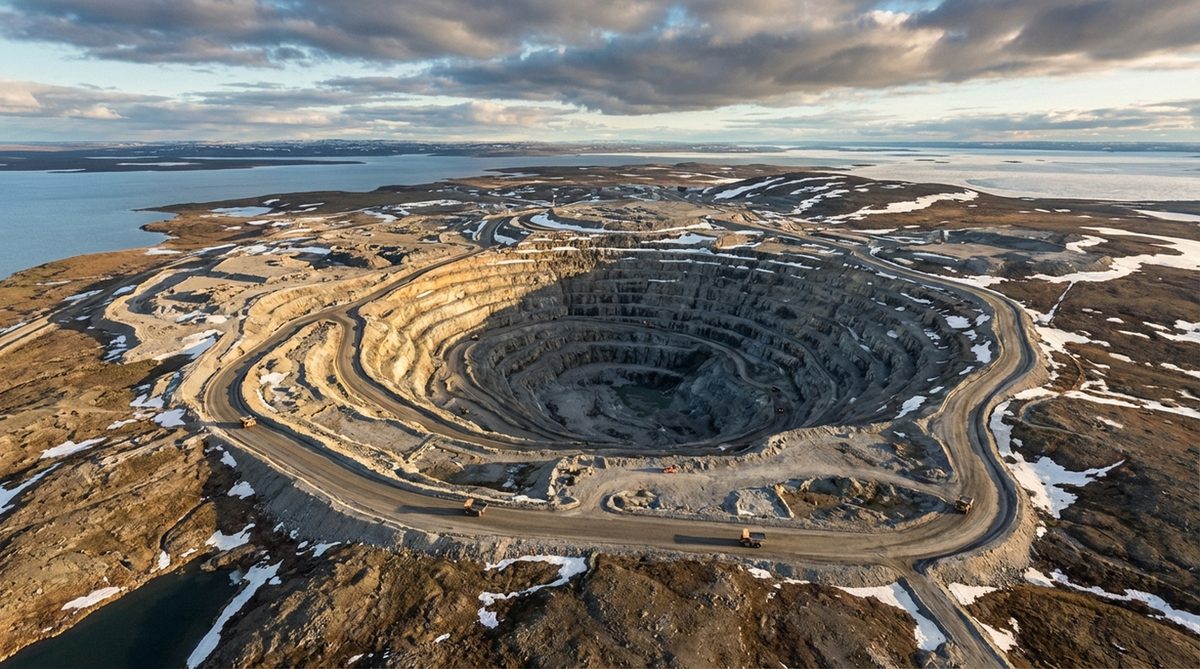
Commercial production began in October 1998 when BHP Billiton opened the Ekati Diamond Mine, approximately 300 kilometres northeast of Yellowknife. Within five years, two more world-class operations followed: the Diavik Diamond Mine (a joint venture between Rio Tinto and Dominion Diamond) in 2003, and the Snap Lake Mine (De Beers) in 2008. By 2003, Canada had become the world's third-largest diamond producer by value, a position it held for over a decade.
The industry's rapid growth reshaped the economy of the Northwest Territories. Diamond mining replaced gold as the territory's primary mining activity and created thousands of high-paying jobs, many reserved under Impact and Benefit Agreements (IBAs) for Indigenous communities. Yellowknife developed a cutting and polishing sector, and the Government of the Northwest Territories established a certification programme to guarantee Canadian provenance.
Today the industry is in a mature phase. The three active mines — Ekati, Diavik, and Gahcho Kué — collectively produce between 12 and 15 million carats per year. While this is below the peak output of 23 million carats achieved in 2007, the average per-carat value has risen steadily, reflecting a shift toward deeper kimberlite pipes that yield higher proportions of gem-quality stones.
Several factors distinguish Canadian diamonds in the global market. The country's rigorous regulatory framework — covering environmental assessment, mine closure planning, water management, and wildlife monitoring — ensures that operations meet standards unmatched in most other diamond-producing jurisdictions. Combined with the Kimberley Process certification and provincial/territorial origin tracking, Canadian diamonds carry a provenance guarantee that resonates with ethically minded consumers in North America, Europe, and Asia.
Canadian Diamond Production 1998–2024
The chart below tracks annual rough diamond production in millions of carats alongside estimated mine-gate value in billions of Canadian dollars. Production climbed steeply during the early 2000s as new mines came online, reached a plateau between 2005 and 2008, and then entered a gradual decline as open-pit resources at Ekati and Diavik transitioned to underground mining. The opening of Gahcho Kué in 2016 provided a production boost that partially offset declining output from older operations.
| Year | Production (M carats) | Value (CAD $B) | Active Mines |
|---|---|---|---|
| 1998 | 0.6 | $0.07 | 1 (Ekati) |
| 2000 | 2.5 | $0.55 | 1 |
| 2003 | 11.2 | $1.73 | 2 |
| 2005 | 14.8 | $2.07 | 2 |
| 2007 | 23.0 | $2.70 | 3 |
| 2010 | 11.8 | $2.30 | 3 |
| 2012 | 10.5 | $2.14 | 3 |
| 2014 | 11.6 | $2.38 | 3 |
| 2016 | 13.0 | $2.10 | 4 |
| 2018 | 23.2 | $2.47 | 4 |
| 2020 | 13.6 | $1.35 | 3 |
| 2022 | 16.2 | $2.51 | 3 |
| 2024 | 13.3 | $1.47 | 3 |
Several trends are evident in the data. First, the dramatic production ramp-up between 1998 and 2007 reflects the sequential opening of Ekati (1998), Diavik (2003), and Snap Lake (2008). Second, the 2009–2010 downturn — when output fell to 11.8 million carats — coincided with the global financial crisis, which depressed rough diamond prices and led operators to reduce throughput. Third, the 2018 spike to 23.2 million carats resulted from the simultaneous processing of high-grade ore bodies at Diavik and the full commissioning of Gahcho Kué. Finally, the 2020 dip to 13.6 million carats reflected COVID-19 shutdowns that temporarily halted all three NWT operations.
Canadian Diamond Trade Flows
Canada exports the vast majority of its rough diamond production. According to Natural Resources Canada and Statistics Canada trade data, rough diamond exports in 2023 totalled CAD $2.1 billion, while polished diamond exports added another CAD $186 million. The country also imports significant quantities of polished diamonds for its retail jewellery market, creating a complex two-way trade pattern.
The primary export destinations for Canadian rough diamonds are:
| Destination | Share of Exports (%) | Estimated Value (CAD $M) | Primary Use |
|---|---|---|---|
| Belgium (Antwerp) | 38% | $798 | Sorting, trading, re-export |
| India | 29% | $609 | Cutting & polishing |
| United Kingdom | 12% | $252 | Trading & aggregation |
| Israel | 8% | $168 | Speciality cutting |
| Botswana | 6% | $126 | De Beers aggregation |
| Other | 7% | $147 | Various |
Belgium's dominant share reflects Antwerp's historical role as the world's primary rough diamond trading hub. Indian buyers receive the second-largest share, driven by the country's cost-efficient cutting and polishing infrastructure in cities like Surat and Mumbai. The United Kingdom and Israel serve as secondary trading and speciality manufacturing centres, while Botswana's share reflects De Beers' aggregation of production from its global operations (including Gahcho Kué) through its Gaborone-based sightholder system.
On the import side, Canada imports approximately CAD $800 million to $1 billion in polished diamonds annually, primarily from India (48%), Belgium (22%), the United States (14%), and Israel (9%). These polished stones feed the domestic retail jewellery market, which is valued at roughly CAD $3.2 billion per year. Notably, some Canadian rough diamonds are exported, cut overseas, and then reimported as polished stones — a circular trade pattern common in the global diamond pipeline.
Mine-by-Mine Production Breakdown
Each of Canada's three active diamond mines has distinct geological characteristics, ownership structures, and production profiles. The table below provides a comparative summary, with links to detailed individual mine pages.
| Mine | Location | Owner(s) | Opened | 2024 Output (M ct) | Expected Closure |
|---|---|---|---|---|---|
| Ekati | Lac de Gras, NWT | Arctic Canadian Diamond Company | 1998 | 4.8 | Early 2030s |
| Diavik | Lac de Gras, NWT | Rio Tinto (100%) | 2003 | 3.7 | 2026 |
| Gahcho Kué | Kennady Lake, NWT | De Beers (51%) / Mountain Province (49%) | 2016 | 4.8 | 2030+ |
Ekati Diamond Mine
Ekati holds the distinction of being Canada's first diamond mine. Originally developed by BHP Billiton, the operation has changed hands multiple times — passing through Dominion Diamond, Washington Companies, and ultimately Arctic Canadian Diamond Company, which acquired the mine out of creditor protection in 2023. The mine encompasses multiple open-pit and underground kimberlite pipes across the Ekati property. Key pipes include Panda (now depleted), Fox, Koala, Misery, Pigeon, Lynx, and the recently permitted Point Lake. Underground operations at Koala North and Misery Deep extract higher-grade ore at greater depth. In 2024, Ekati processed approximately 3.2 million tonnes of kimberlite to yield 4.8 million carats, at an average grade of 1.5 carats per tonne. Detailed production data, geology, and employment figures are available on the Ekati mine profile page.
Diavik Diamond Mine
Located on a 20-square-kilometre island in Lac de Gras — just 30 kilometres southeast of Ekati — Diavik is operated by Rio Tinto, which acquired full ownership in 2021 after purchasing Dominion Diamond's 40% stake. The mine exploits four kimberlite pipes (A154 South, A154 North, A418, and A21) that intrude through the lakebed. Diavik is notable for its engineering: water was drained from sections of the lake to enable open-pit mining, and subsequent underground operations accessed deeper portions of the ore bodies. In 2024, Diavik produced 3.7 million carats from underground mining exclusively, as all open pits have been exhausted. The mine is expected to enter closure and remediation in 2026. Visit the Diavik mine profile for the full operational timeline.
Gahcho Kué Diamond Mine
Gahcho Kué, located at Kennady Lake approximately 280 kilometres northeast of Yellowknife, is the newest large-scale diamond mine in Canada. Operated by De Beers Canada and jointly owned with Mountain Province Diamonds, the mine began commercial production in March 2017 and quickly ramped up to become Canada's highest-grade operation by carat-per-tonne. Three kimberlite pipes — 5034, Hearne, and Tuzo — are being mined in sequence using open-pit methods. In 2024, Gahcho Kué produced 4.8 million carats at a recovered grade of approximately 2.0 carats per tonne. The mine plan extends into the early 2030s, contingent on successful extraction of the Tuzo pipe. Full details are on the Gahcho Kué mine profile.
Inactive and Closed Mines
Two other mines have contributed to Canadian production. The Snap Lake Mine, operated by De Beers approximately 220 kilometres northeast of Yellowknife, produced diamonds from 2008 to 2015 before high costs and geological challenges led to its closure. De Beers placed the mine into indefinite care and maintenance and is currently conducting long-term remediation. The Renard Mine in Québec's James Bay region, operated by Stornoway Diamond Corporation and later Osisko Development, produced diamonds from 2017 to early 2024 before financial difficulties and declining grades prompted a suspension of operations.
Economic Contribution of Diamond Mining in Canada
The diamond mining industry has been a transformative economic force in northern Canada, particularly in the Northwest Territories. Since production began in 1998, the cumulative direct economic contribution exceeds CAD $27.7 billion in mine-gate diamond sales alone. When indirect and induced effects are included — supply chain spending, wages, government revenues, and community investments — the total economic footprint is substantially larger.
| Metric | Value |
|---|---|
| Cumulative rough diamond production value | CAD $27.7 billion |
| Royalties paid to NWT government | CAD $1.4 billion (est.) |
| Corporate and income taxes paid | CAD $3.2 billion (est.) |
| Direct employment (2024) | ~3,800 jobs |
| Indirect/induced employment (2024) | ~7,500 jobs |
| IBA payments to Indigenous communities | CAD $1.8 billion (est.) |
| Share of NWT GDP (2024) | ~16% |
| Northern and Indigenous business procurement | CAD $7.9 billion (cumulative) |
Diamond mining accounts for approximately 16% of the Northwest Territories' gross domestic product, making it the single largest private-sector contributor to the territorial economy. Beyond the mines themselves, a network of service providers, transportation companies, catering firms, environmental consultancies, and construction contractors depend on diamond mining activity. The City of Yellowknife estimates that roughly one in five private-sector jobs in the territorial capital is directly or indirectly linked to the diamond industry.
The Government of the Northwest Territories collects diamond royalties based on the value of production. Since 2014, the territory has also received a share of federal resource revenues under the NWT Devolution Agreement, further increasing the fiscal benefit of diamond mining. Combined royalties and taxes from the diamond sector have funded infrastructure improvements, healthcare services, and education programmes across the North.
For a deeper analysis of employment data, GDP contributions, government revenues, and community investment programmes, see the Economic Impact of Canadian Diamond Mining report.
Future Outlook for Canadian Diamond Mining
The Canadian diamond industry faces a transition period over the coming decade. Two of the three active mines are approaching the end of their planned mine lives, and no new large-scale projects are currently under construction. However, several factors could sustain or even grow the industry beyond current projections.
Mine Life Extensions
Arctic Canadian Diamond Company is pursuing several new kimberlite pipes at Ekati that could extend the mine's life into the 2030s. The Point Lake pipe received environmental assessment approval in 2023, and exploration drilling has identified additional targets on the property. At Gahcho Kué, De Beers and Mountain Province are evaluating the potential for underground mining beneath the Tuzo pit, which could add several years of production beyond the current open-pit plan.
The Diavik Closure
Diavik's expected closure in 2026 will remove approximately 3–4 million carats of annual production from the Canadian total. Rio Tinto has developed a comprehensive closure plan that includes progressive reclamation of waste rock and processed kimberlite storage areas, the re-flooding of mined-out pits, and long-term water quality monitoring. The closure will also reduce direct employment in the NWT by approximately 1,100 positions, presenting a significant economic adjustment challenge for northern communities.
Exploration Pipeline
Diamond exploration continues across multiple Canadian provinces and territories. Notable advanced-stage projects include:
- Star-Orion South (Saskatchewan): Rio Tinto's project near Prince Albert represents the most advanced new diamond project in Canada. The Fort à la Corne kimberlite field contains one of the world's largest diamond deposits by tonnage, though at a lower grade than NWT mines.
- Chidliak (Nunavut): De Beers' property on Baffin Island has yielded high-value stones from multiple kimberlite bodies. Bulk sampling has confirmed commercial potential, though remoteness and infrastructure costs present challenges.
- Victor Mine Area (Ontario): Although the Victor Mine near Attawapiskat closed in 2019, De Beers retains mineral rights in the area and has identified several satellite kimberlite bodies that could support a future operation.
- Kennady North (NWT): Mountain Province Diamonds holds exploration rights adjacent to Gahcho Kué, where the Kelvin and Faraday kimberlite bodies have shown promising diamond content in preliminary sampling.
Market Factors
The global rough diamond market is undergoing structural shifts that will influence Canadian production decisions. Growing demand in China and India, tightening supply from aging mines worldwide, and increasing consumer preference for ethically sourced stones could support higher prices for Canadian production. Conversely, the rapid growth of the lab-grown diamond sector is compressing margins in the lower-quality segment of the market, though it has had minimal impact on the premium-priced Canadian natural diamond segment to date.
Analysts project that Canadian diamond production will decline from the current 13–15 million carat range to approximately 8–10 million carats by 2028, primarily due to Diavik's closure. Whether production stabilises at that level or continues to decline will depend on the success of Ekati's mine-life extension and the development of new projects. Regardless of volume trends, Canada's reputation for high-quality, ethically produced diamonds positions the country to maintain its premium market positioning.
Explore More Industry Data
Canadian Diamond Mines Map
Interactive map of all active, closed, and planned diamond mines across Canada with geological data and ownership details.
Economic Impact Analysis
Detailed breakdown of employment, GDP contribution, government revenues, and Indigenous economic participation in diamond mining.
Canada vs. Global Producers
How Canada's diamond output, value, and quality compare to Russia, Botswana, Angola, South Africa, and other major producers.
The Canadian Diamond Story
From Chuck Fipke's discovery at Lac de Gras to a multi-billion-dollar industry — the complete history of diamonds in Canada.
Ethical Sourcing Standards
How Canada's regulatory framework, Kimberley Process participation, and origin certification ensure conflict-free diamonds.
Diamond Price Calculator
Estimate the retail value of a diamond based on carat weight, cut, colour, and clarity using current Canadian market data.
Frequently Asked Questions About Canadian Diamonds
How many diamonds does Canada produce per year?
Canada produced approximately 13.3 million carats of rough diamonds in 2024, valued at roughly CAD $1.47 billion. Production has fluctuated over the years, peaking at around 23 million carats in 2007 before stabilising at current levels as older mines mature and newer operations ramp up. Annual output is expected to decline further when the Diavik mine closes in 2026.
Where does Canada rank among global diamond producers?
Canada ranks as the world's fourth-largest diamond producer by value and fifth by volume. It trails Russia (Alrosa), Botswana (Debswana), and the Democratic Republic of Congo in carat output, but its diamonds command premium prices due to high gem-quality percentages and ethical sourcing standards. See the Canada vs. World Producers page for detailed comparisons.
Which mines produce diamonds in Canada?
As of 2024, three mines are actively producing diamonds in Canada: the Ekati Diamond Mine (opened 1998), the Diavik Diamond Mine (opened 2003), and the Gahcho Kué Diamond Mine (opened 2016). All three are located in the Northwest Territories. The Renard Mine in Québec operated from 2017 to 2024 before entering care and maintenance. View all mines on the interactive mines map.
What is the total economic contribution of Canadian diamond mining?
Since commercial production began in 1998, the Canadian diamond mining industry has contributed an estimated CAD $27.7 billion to the national economy through mine-gate diamond sales. Including royalties, taxes, wages, supply chain spending, and community payments, the total economic footprint is considerably larger. In the Northwest Territories alone, diamond mining accounts for roughly 16% of territorial GDP and supports approximately 3,800 direct jobs and 7,500 indirect jobs. Full details are in our Economic Impact analysis.
Are Canadian diamonds ethically sourced?
Yes. Canadian diamonds are mined under some of the strictest environmental and labour regulations in the world. Every Canadian diamond can be traced from mine to market through the Canadian Diamond Code of Conduct and government-issued certificates of origin. Canada is a founding participant of the Kimberley Process Certification Scheme, which prevents conflict diamonds from entering the legitimate supply chain. Learn more about ethical diamond sourcing.
Who buys Canadian rough diamonds?
The majority of Canadian rough diamonds are sold through long-term supply agreements to cutting and polishing centres in Belgium (Antwerp), India (Surat and Mumbai), Israel, and Botswana. Belgium accounts for roughly 38% of rough exports by value, followed by India at 29%. A growing domestic cutting and polishing industry in Yellowknife also processes a portion of production for the branded Canadian diamond retail market.
What is the future outlook for diamond mining in Canada?
The Diavik mine is scheduled to cease production by 2026, and Ekati's remaining open-pit and underground resources will extend operations into the early 2030s. Gahcho Kué is expected to produce until at least 2030. Exploration projects in Ontario, Québec, Nunavut, and Saskatchewan could yield new mines, though none are currently in the advanced permitting stage. Industry analysts expect Canadian production to settle in the 8–10 million carat range by 2028.
How does Canadian diamond production compare to lab-grown diamonds?
While lab-grown diamond production has surged globally — accounting for an estimated 15–20% of the gem-quality market by 2024 — Canadian mined diamonds retain a distinct market position. Their natural origin, government certification, and provenance story command a significant price premium over lab-grown equivalents, particularly in North American and Asian luxury markets. For a full comparison, see our Lab-Grown vs. Natural Diamonds guide.
Data sources: Natural Resources Canada, Statistics Canada, NWT Bureau of Statistics, company annual reports (Rio Tinto, De Beers, Arctic Canadian Diamond Company, Mountain Province Diamonds). Last updated March 2026.